
The alkyl carbocation is estimated to be 15 kcal/mol more stable than the alkenyl carbocation. If this is also the difference in the energies of the transition state leading to each, what is the expected rate difference?
<IMAGE>

Mullins 1st Edition
Ch. 10 - Alkynes: Electrophilic Addition and Redox Reactions
Problem 34a
Verified step by step guidance
The alkyl carbocation is estimated to be 15 kcal/mol more stable than the alkenyl carbocation. If this is also the difference in the energies of the transition state leading to each, what is the expected rate difference?
<IMAGE>
We have studied the following reactions in previous chapters. For each, (i) indicate which reaction sheets they should appear on, (ii) show the best structure to use to represent them, and (iii) write the notes you could put in the margin so that the mechanism is implied.
(b) Radical halogenation of an alkane
Predict the major products resulting from the addition of one equivalent of HX to the following alkynes.
(b)
Draw the ketone(s) you would expect to form by reacting the following alkynes under the conditions of oxymercuration: (a) 6-methyloct-1-yne, (b) 1,10-dicyclohexyldec-5-yne, and (c) 5-phenylhex-2-yne.
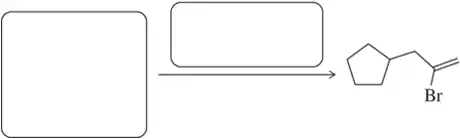
Predict the alkyne and reactants you might use to make the following haloalkenes. [Providing the reactant and the reagent is how we start thinking about synthesis.]
(b)
Draw the ketone(s) you would expect to form by treating the following alkynes under the conditions of hydroboration–oxidation: (a) 6-methyloct-1-yne, (b) 1,10-dicyclohexyldec-5-yne, and (c) 5-phenylhex-2-yne.
<IMAGE>