Ch. 10 - Alkynes: Electrophilic Addition and Redox Reactions
Mullins - Organic Chemistry: A Learner Centered Approach 1st Edition
Mullins1st EditionOrganic Chemistry: A Learner Centered ApproachISBN: 9780137566471Not the one you use?Change textbook
Chapter 9, Problem 31b

We have studied the following reactions in previous chapters. For each, (i) indicate which reaction sheets they should appear on, (ii) show the best structure to use to represent them, and (iii) write the notes you could put in the margin so that the mechanism is implied.
(b) Radical halogenation of an alkane

Verified step by step guidance
1
Identify the type of reaction: Radical halogenation of an alkane is a substitution reaction where a hydrogen atom in the alkane is replaced by a halogen atom, typically chlorine or bromine.
Determine the reaction sheet: This reaction should appear on the 'Radical Reactions' sheet, as it involves the formation and reaction of radicals.
Represent the structure: Use a simple alkane, such as methane (CH₄), and a halogen molecule, such as Cl₂, to represent the starting materials. The product will be a haloalkane, such as chloromethane (CH₃Cl).
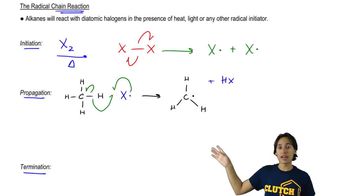
Write margin notes: Indicate that the mechanism involves three main steps: initiation, propagation, and termination. Initiation involves the homolytic cleavage of the Cl-Cl bond to form two chlorine radicals. Propagation involves the abstraction of a hydrogen atom from the alkane by a chlorine radical, forming a methyl radical and HCl. The methyl radical then reacts with another Cl₂ molecule to form chloromethane and another chlorine radical. Termination involves the combination of radicals to form stable molecules.
Use MathML for chemical expressions: Represent the chemical reaction using MathML. For example, the initiation step can be written as: Cl2Cl2Cl2

Verified video answer for a similar problem:

This video solution was recommended by our tutors as helpful for the problem above.
Video duration:
5m
Was this helpful?

Key Concepts

Here are the essential concepts you must grasp in order to answer the question correctly.

Radical Halogenation

Radical halogenation is a reaction where alkanes react with halogens, typically chlorine or bromine, under UV light or heat to form haloalkanes. The process involves the formation of free radicals, which are highly reactive species with unpaired electrons. This reaction proceeds through initiation, propagation, and termination steps, making it crucial to understand the radical mechanism.
Recommended video:
Guided course
12:11
Radical Chain Reaction Mechanism.

Free Radical Mechanism

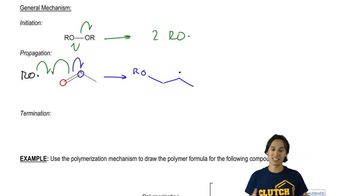
The free radical mechanism is a chain reaction involving radicals, which are atoms or molecules with unpaired electrons. In radical halogenation, the mechanism starts with the homolytic cleavage of a halogen molecule, forming radicals. These radicals then react with alkanes to form new radicals, propagating the reaction until termination occurs when radicals combine to form stable molecules.
Recommended video:
Guided course
03:28
The mechanism of Radical Polymerization.

Alkane Structure Representation

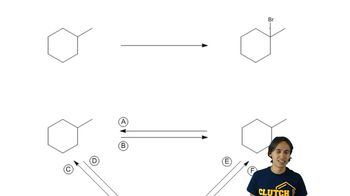
Alkanes are saturated hydrocarbons consisting of carbon and hydrogen atoms with single bonds. In radical halogenation, it's essential to represent the alkane structure accurately, showing all hydrogen atoms, as they are potential sites for halogen substitution. The structural representation helps in visualizing the reaction sites and understanding the regioselectivity of the halogenation process.
Recommended video:
Guided course
02:47
Functionalizing Alkanes