Ch. 10 - Alkynes: Electrophilic Addition and Redox Reactions
Mullins - Organic Chemistry: A Learner Centered Approach 1st Edition
Mullins1st EditionOrganic Chemistry: A Learner Centered ApproachISBN: 9780137566471Not the one you use?Change textbook
Chapter 9, Problem 29

Sodium amide, the base we use to deprotonate terminal alkynes, is synthesized by reducing ammonia via a mechanism similar to the reduction of alkynes in Figure 10.21. Suggest a mechanism for this reaction.

Verified step by step guidance
1
Step 1: Begin by recognizing that sodium amide (NaNH₂) is formed by the reaction of ammonia (NH₃) with metallic sodium (Na⁰). The reaction also produces hydrogen gas (H₂) as a byproduct.
Step 2: Understand that metallic sodium (Na⁰) acts as a reducing agent. Sodium donates an electron to ammonia, initiating the formation of a radical intermediate. This is similar to the reduction mechanism seen in alkynes.
Step 3: Propose the first step of the mechanism: Sodium donates an electron to ammonia (NH₃), forming an ammonia radical anion (NH₃⁻•). This radical anion is highly reactive.
Step 4: The ammonia radical anion (NH₃⁻•) undergoes proton transfer, where it loses a proton to form the amide ion (NH₂⁻) and hydrogen gas (H₂). This step is facilitated by the presence of another ammonia molecule acting as a proton donor.
Step 5: Finally, the amide ion (NH₂⁻) combines with sodium cation (Na⁺) to form sodium amide (NaNH₂). This process repeats for the second ammonia molecule, resulting in the overall reaction: 2 NH₃ + 2 Na⁰ → 2 NaNH₂ + H₂.

Verified video answer for a similar problem:

This video solution was recommended by our tutors as helpful for the problem above.
Video duration:
4m
Was this helpful?

Key Concepts

Here are the essential concepts you must grasp in order to answer the question correctly.

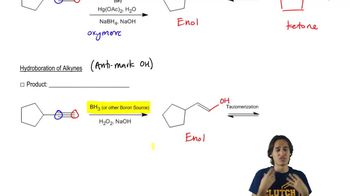
Deprotonation of Terminal Alkynes

Deprotonation of terminal alkynes involves the removal of a proton from the terminal carbon atom, resulting in the formation of an alkyne anion. This process is typically facilitated by strong bases like sodium amide (NaNH₂), which can effectively abstract the acidic hydrogen due to the high acidity of terminal alkynes compared to other hydrocarbons.
Recommended video:
Guided course
02:43
Anti-Markovnikov addition of alcohols to terminal alkynes yields aldehydes

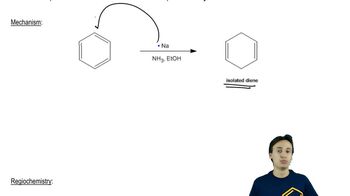
Reduction Mechanisms

Reduction mechanisms in organic chemistry refer to the processes that involve the gain of electrons or hydrogen, or the loss of oxygen. In the context of synthesizing sodium amide from ammonia, the reduction of ammonia involves the transfer of electrons from sodium metal to ammonia, resulting in the formation of sodium amide and hydrogen gas.
Recommended video:
Guided course
04:40
Birch Reduction Mechanism

Sodium Amide Synthesis

Sodium amide (NaNH₂) is synthesized through the reduction of ammonia (NH₃) using sodium metal (Na). This reaction is significant in organic synthesis as sodium amide serves as a strong base for deprotonating terminal alkynes, enabling further reactions such as nucleophilic substitutions or eliminations in organic synthesis.
Recommended video:
Guided course
01:33
Amide Nomenclature