Ch. 10 - Alkynes: Electrophilic Addition and Redox Reactions
Mullins - Organic Chemistry: A Learner Centered Approach 1st Edition
Mullins1st EditionOrganic Chemistry: A Learner Centered ApproachISBN: 9780137566471Not the one you use?Change textbook
Chapter 9, Problem 39a

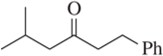
For each of the following ketones/aldehydes, indicate whether it is possible to synthesize it from an alkyne as the only compound in good ( > 50%) yield. If so, how would you do it?
(a) Chemical structure of a ketone with a phenyl group, featuring a carbonyl group and a branched carbon chain.

Verified step by step guidance
1
Step 1: Understand the problem. The question asks whether a given ketone or aldehyde can be synthesized from an alkyne in good yield (> 50%). This involves identifying the appropriate reaction mechanism and reagents to convert an alkyne into the desired carbonyl compound.
Step 2: Recall the relevant reactions. Alkynes can be converted into ketones or aldehydes through hydration reactions. Specifically, (1) acid-catalyzed hydration using H₂SO₄ and HgSO₄ leads to ketones via Markovnikov addition, and (2) hydroboration-oxidation using BH₃ (or a bulky borane like 9-BBN) followed by H₂O₂/NaOH leads to aldehydes via anti-Markovnikov addition.
Step 3: Analyze the structure of the given ketone or aldehyde. Determine whether the carbonyl group is located at the Markovnikov or anti-Markovnikov position relative to the alkyne. This will help you decide which reaction pathway to use.
Step 4: Propose the synthesis. If the carbonyl group is at the Markovnikov position, use acid-catalyzed hydration. If it is at the anti-Markovnikov position, use hydroboration-oxidation. Write the reaction mechanism and specify the reagents for the transformation.
Step 5: Evaluate the feasibility. Ensure that the reaction conditions are compatible with the alkyne and that the desired product can be obtained in good yield (> 50%). If the reaction is not feasible, explain why (e.g., steric hindrance, competing side reactions).

Verified video answer for a similar problem:

This video solution was recommended by our tutors as helpful for the problem above.
Video duration:
8m
Was this helpful?

Key Concepts

Here are the essential concepts you must grasp in order to answer the question correctly.

Alkynes

Alkynes are hydrocarbons that contain at least one carbon-carbon triple bond. They are unsaturated compounds and can undergo various reactions, including addition reactions, which are crucial for synthesizing other organic compounds. Understanding the reactivity of alkynes is essential for determining how they can be transformed into ketones or aldehydes.
Recommended video:
Guided course
09:11
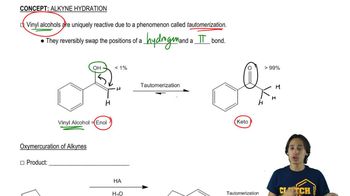
Alkyne Hydration

Hydroboration-Oxidation

Hydroboration-oxidation is a two-step reaction process used to convert alkynes into aldehydes or ketones. In the first step, an alkyne reacts with diborane (B2H6) to form an organoborane intermediate, which is then oxidized with hydrogen peroxide (H2O2) in the presence of a base. This method allows for the selective formation of aldehydes from terminal alkynes and ketones from internal alkynes.
Recommended video:
Guided course
06:38
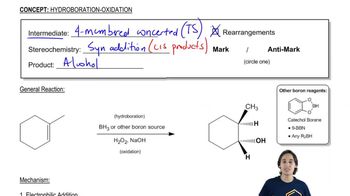
General properties of hydroboration-oxidation.

Markovnikov's Rule

Markovnikov's Rule states that in the addition of HX to an alkene or alkyne, the hydrogen atom will attach to the carbon with the greater number of hydrogen atoms already attached. This principle is crucial when considering the synthesis of ketones and aldehydes from alkynes, as it helps predict the regioselectivity of the reactions and the resulting products formed during hydroboration or other addition reactions.
Recommended video:
Guided course
03:54
The 18 and 16 Electron Rule