Ch. 8 - Delocalized Electrons: Their Effect on Stability, pKa, and the Products of a Reaction • Aromaticity and Electronic Effects: An Introduction to the Reactions of Benzene
Bruice - Organic Chemistry 8th Edition
Bruice8th EditionOrganic ChemistryISBN: 9780135213711Not the one you use?Change textbook
Chapter 9, Problem 94b

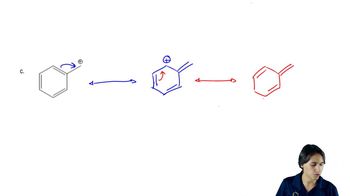
Draw the resonance contributors for phenol.

Verified step by step guidance
1
Step 1: Understand the structure of the anilinium ion. The anilinium ion is derived from aniline (C6H5NH2) by protonation of the amino group, resulting in a positively charged nitrogen (NH3+).
Step 2: Recognize that resonance contributors involve the delocalization of electrons. In the anilinium ion, the positive charge on the nitrogen can interact with the π-electrons of the benzene ring.
Step 3: Draw the first resonance structure. This structure shows the positive charge localized on the nitrogen atom, with the benzene ring intact and no movement of π-electrons.
Step 4: Draw the second resonance structure. Move one pair of π-electrons from the benzene ring to form a double bond between the nitrogen and one of the carbon atoms in the ring. This results in the positive charge being delocalized onto the benzene ring.
Step 5: Draw additional resonance structures by moving the π-electrons around the benzene ring. Each structure will show the positive charge delocalized on different carbon atoms of the ring, maintaining the overall stability of the ion through resonance.

Verified video answer for a similar problem:

This video solution was recommended by our tutors as helpful for the problem above.
Video duration:
4m
Was this helpful?

Key Concepts

Here are the essential concepts you must grasp in order to answer the question correctly.

Resonance Structures

Resonance structures are different Lewis structures for the same molecule that depict the delocalization of electrons. In the case of the anilinium ion, resonance contributors illustrate how the positive charge can be distributed across the aromatic ring, enhancing stability. These structures are not real entities but rather a way to represent the hybridization of electron density in a molecule.
Recommended video:
Guided course
03:04
Drawing Resonance Structures

Anilinium Ion

The anilinium ion is the protonated form of aniline, characterized by a positively charged nitrogen atom bonded to a phenyl group. This ion is important in organic chemistry as it demonstrates how aromatic systems can stabilize positive charges through resonance. Understanding its structure helps in predicting its reactivity and interactions in various chemical environments.
Recommended video:
3:39
Metal Ion Catalysis Concept 1

Aromaticity

Aromaticity refers to the enhanced stability of cyclic, planar molecules with conjugated pi electron systems that follow Hückel's rule (4n + 2 pi electrons). In the context of the anilinium ion, the aromatic ring contributes to the stability of the positive charge through resonance, making it a key concept in understanding the behavior of such ions in chemical reactions.
Recommended video:
Guided course
08:19
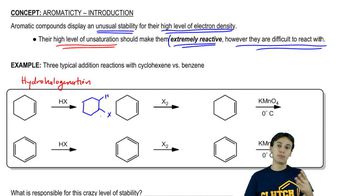
Intro to Aromaticity