Ch. 8 - Delocalized Electrons: Their Effect on Stability, pKa, and the Products of a Reaction • Aromaticity and Electronic Effects: An Introduction to the Reactions of Benzene
Bruice - Organic Chemistry 8th Edition
Bruice8th EditionOrganic ChemistryISBN: 9780135213711Not the one you use?Change textbook
Chapter 9, Problem 95e,f

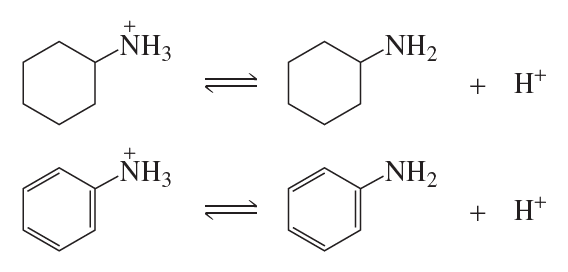
Protonated cyclohexylamine has a Ka = 1 * 10-11. Using the same sequence of steps as in Problem 94, determine which is a stronger base: cyclohexylamine
or aniline.
Chemical structures illustrating the equilibrium between cyclohexylammonium ion and cyclohexylamine, and anilinium ion and aniline.
e. Which has a greater Ka: cyclohexylammmonium ion or anilinium ion?
f. Which is a stronger acid: cyclohexylamine or aniline?

Verified step by step guidance
1
Step 1: Understand the relationship between Ka and acid strength. Ka (acid dissociation constant) measures the strength of an acid. A higher Ka value indicates a stronger acid because it dissociates more in solution.
Step 2: Compare the structures of cyclohexylammonium ion and anilinium ion. Cyclohexylammonium ion is derived from cyclohexylamine, which is an aliphatic amine, while anilinium ion is derived from aniline, which is an aromatic amine. The aromatic ring in aniline can stabilize the positive charge on the conjugate acid (anilinium ion) through resonance.
Step 3: Analyze the conjugate bases. Cyclohexylamine forms a conjugate base (cyclohexylamine) that lacks resonance stabilization, while aniline forms a conjugate base (aniline) that is resonance-stabilized. This stabilization makes aniline a weaker base, and thus its conjugate acid (anilinium ion) is a stronger acid with a higher Ka.
Step 4: Address part (f) by considering the inverse relationship between acid strength and base strength. Cyclohexylamine is a stronger base because it lacks resonance stabilization, making it less likely to donate a proton. Aniline, being resonance-stabilized, is a weaker base and thus a stronger acid.
Step 5: Summarize the findings. For part (e), the anilinium ion has a greater Ka because it is a stronger acid due to resonance stabilization. For part (f), cyclohexylamine is a stronger base, meaning aniline is the stronger acid.

Verified video answer for a similar problem:

This video solution was recommended by our tutors as helpful for the problem above.
Video duration:
5m
Was this helpful?

Key Concepts

Here are the essential concepts you must grasp in order to answer the question correctly.

Acid Dissociation Constant (Ka)

The acid dissociation constant (Ka) quantifies the strength of an acid in solution. It measures the extent to which an acid donates protons (H+) to water, forming its conjugate base. A higher Ka value indicates a stronger acid, as it signifies a greater tendency to lose protons. Understanding Ka is essential for comparing the acidity of different compounds.
Recommended video:
Guided course
02:19
The relationship between equilibrium constant and pKa.

Conjugate Acid-Base Pairs

Conjugate acid-base pairs consist of an acid and its corresponding base that differ by a single proton. When an acid donates a proton, it forms its conjugate base, which can accept a proton back. The stability of the conjugate base influences the strength of the acid; more stable conjugate bases correspond to stronger acids. This concept is crucial for evaluating the relative acidity of cyclohexylamine and aniline.
Recommended video:
2:56
Base Pairing Concept 1

Inductive Effect and Resonance

The inductive effect refers to the electron-withdrawing or electron-donating influence of substituents on a molecule, affecting its acidity. Resonance involves the delocalization of electrons across a molecule, stabilizing the conjugate base. In the case of aniline, the amino group can participate in resonance, which affects its acidity compared to cyclohexylamine, where such resonance is absent. Understanding these effects is vital for predicting acid strength.
Recommended video:
Guided course
01:47
Understanding the Inductive Effect.