
Ch. 8 - Delocalized Electrons: Their Effect on Stability, pKa, and the Products of a Reaction • Aromaticity and Electronic Effects: An Introduction to the Reactions of Benzene
Bruice - Organic Chemistry 8th Edition
Bruice8th EditionOrganic ChemistryISBN: 9780135213711Not the one you use?Change textbook
Chapter 9, Problem 98a(2)

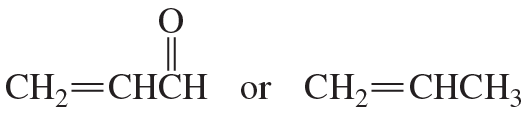
Which dienophile in each pair is more reactive in a Diels–Alder reaction?
2. Comparison of two dienophiles: one with a carbonyl group and the other with a methyl group.

Verified step by step guidance
1
Identify the general principle of the Diels–Alder reaction: The reactivity of a dienophile depends on the presence of electron-withdrawing groups (EWGs) attached to it. These groups lower the energy of the dienophile's lowest unoccupied molecular orbital (LUMO), making it more reactive toward the diene's highest occupied molecular orbital (HOMO).
Examine the structure of each dienophile in the pair. Look for electron-withdrawing groups such as carbonyl groups (C=O), nitriles (-C≡N), nitro groups (-NO₂), or halogens. The dienophile with more or stronger EWGs will generally be more reactive.
Consider the electronic effects of substituents: If one dienophile has substituents that are electron-donating (e.g., alkyl groups) and the other has electron-withdrawing substituents, the one with the EWGs will be more reactive.
Analyze the conjugation and resonance effects: Dienophiles with conjugated systems involving EWGs (e.g., an α,β-unsaturated carbonyl compound) are typically more reactive because the conjugation stabilizes the transition state of the reaction.
Compare the steric effects: If both dienophiles have similar electronic properties, consider steric hindrance. A less sterically hindered dienophile will be more reactive because it can more easily approach the diene to form the cyclic transition state.

Verified video answer for a similar problem:

This video solution was recommended by our tutors as helpful for the problem above.
Was this helpful?

Key Concepts

Here are the essential concepts you must grasp in order to answer the question correctly.

Diels–Alder Reaction

The Diels–Alder reaction is a [4+2] cycloaddition reaction between a conjugated diene and a dienophile, resulting in the formation of a six-membered ring. This reaction is a key method in organic synthesis for constructing cyclic compounds and is characterized by its stereospecificity and regioselectivity. Understanding the mechanism and the factors influencing reactivity is essential for predicting the outcome of the reaction.
Recommended video:
Guided course
04:02
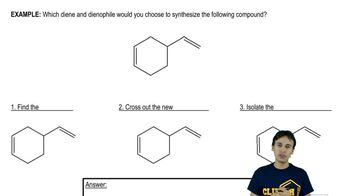
Diels-Alder Retrosynthesis

Dienophile Reactivity

Dienophiles are typically electron-deficient alkenes or alkynes that react with electron-rich dienes in the Diels–Alder reaction. The reactivity of a dienophile is influenced by its electronic properties, such as the presence of electron-withdrawing groups, which enhance its ability to stabilize the transition state. Recognizing how these substituents affect reactivity is crucial for determining which dienophile in a pair is more reactive.
Recommended video:
Guided course
01:17
Reactivity of Molecules

Electronic Effects

Electronic effects refer to the influence of substituents on the electron density of a molecule, impacting its reactivity and stability. In the context of the Diels–Alder reaction, electron-withdrawing groups (like carbonyls or nitriles) increase the reactivity of dienophiles by making them more electrophilic, while electron-donating groups can decrease reactivity. Understanding these effects helps in predicting the preferred dienophile in a given reaction scenario.
Recommended video:
Guided course
04:29
Activity and Directing Effects