Ch. 8 - Delocalized Electrons: Their Effect on Stability, pKa, and the Products of a Reaction • Aromaticity and Electronic Effects: An Introduction to the Reactions of Benzene
Bruice - Organic Chemistry 8th Edition
Bruice8th EditionOrganic ChemistryISBN: 9780135213711Not the one you use?Change textbook
Chapter 9, Problem 101e

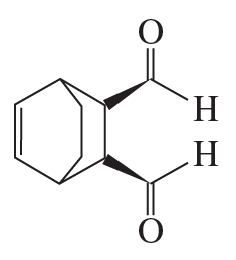
Which diene and which dienophile could be used to prepare each of the following?
e. Chemical structure of a diene and a dienophile, illustrating a Diels-Alder reaction mechanism.

Verified step by step guidance
1
Step 1: Recognize that the product shown is a result of a Diels-Alder reaction, which involves a conjugated diene and a dienophile reacting to form a cyclic compound.
Step 2: Analyze the structure of the product. The bicyclic ring system indicates that the reaction involved a conjugated diene with two double bonds and a dienophile with electron-withdrawing groups.
Step 3: Identify the diene. The two methyl groups on the diene portion suggest that the diene used was 2,3-dimethyl-1,3-butadiene, as it matches the substitution pattern in the product.
Step 4: Identify the dienophile. The ester groups (OCH₃) attached to the cyclohexene ring suggest that the dienophile was dimethyl maleate, which contains two electron-withdrawing ester groups that enhance reactivity in the Diels-Alder reaction.
Step 5: Conclude that the reaction involved 2,3-dimethyl-1,3-butadiene as the diene and dimethyl maleate as the dienophile to produce the given bicyclic compound.

Verified video answer for a similar problem:

This video solution was recommended by our tutors as helpful for the problem above.
Video duration:
3m
Was this helpful?

Key Concepts

Here are the essential concepts you must grasp in order to answer the question correctly.

Diels-Alder Reaction

The Diels-Alder reaction is a [4+2] cycloaddition between a conjugated diene and a dienophile, resulting in the formation of a six-membered ring. This reaction is a key method in organic synthesis for constructing cyclic compounds and is characterized by its stereospecificity and regioselectivity. Understanding the reactivity of dienes and dienophiles is crucial for predicting the products of this reaction.
Recommended video:
Guided course
04:02
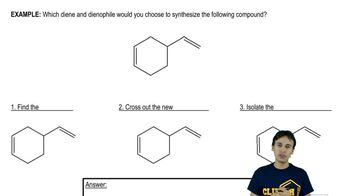
Diels-Alder Retrosynthesis

Diene and Dienophile Selection

Choosing the appropriate diene and dienophile is essential for a successful Diels-Alder reaction. The diene must be in an electron-rich state, typically possessing conjugated double bonds, while the dienophile is often electron-deficient, featuring groups like carbonyls or nitro groups. The electronic and steric properties of both reactants influence the reaction's efficiency and the resulting product's structure.
Recommended video:
Guided course
04:43
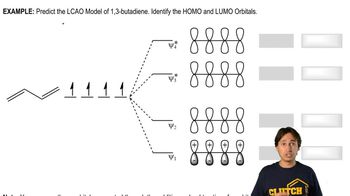
Drawing MO Diagram for Dienes

Retrosynthetic Analysis

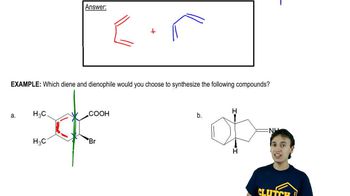
Retrosynthetic analysis is a strategy used in organic chemistry to deconstruct a target molecule into simpler precursor structures. This approach helps chemists identify potential starting materials and reaction pathways to synthesize complex compounds. In the context of the Diels-Alder reaction, it involves determining suitable dienes and dienophiles that can yield the desired product through a logical breakdown of the molecular structure.
Recommended video:
Guided course
01:22
Retrosynthesis