Ch. 8 - Delocalized Electrons: Their Effect on Stability, pKa, and the Products of a Reaction • Aromaticity and Electronic Effects: An Introduction to the Reactions of Benzene
Bruice - Organic Chemistry 8th Edition
Bruice8th EditionOrganic ChemistryISBN: 9780135213711Not the one you use?Change textbook
Chapter 9, Problem 94a

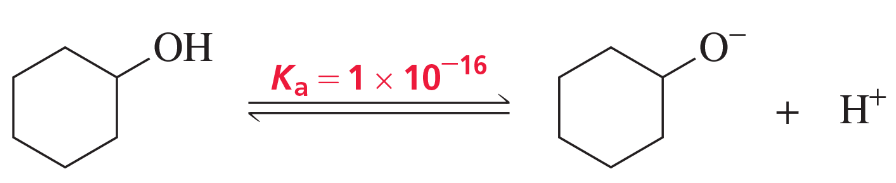
The acid dissociation constant (Ka) for loss of a proton from cyclohexanol is 1 × 10–16.
a. Draw a reaction coordinate diagram for loss of a proton from cyclohexanol.

Verified step by step guidance
1
Step 1: Understand the reaction. Cyclohexanol (C6H11OH) loses a proton (H+) to form cyclohexoxide (C6H11O–) and H+. The acid dissociation constant (Ka = 1×10–16) indicates that the equilibrium strongly favors the reactants, meaning cyclohexanol is a very weak acid.
Step 2: Identify the energy changes. The reaction coordinate diagram will show the energy of the reactants (cyclohexanol), the transition state, and the products (cyclohexoxide and H+). Since the Ka value is very small, the products are much higher in energy compared to the reactants.
Step 3: Draw the starting point. On the reaction coordinate diagram, the reactants (cyclohexanol) should be at a lower energy level because they are more stable.
Step 4: Represent the transition state. The transition state, where the O-H bond is partially broken and the proton is partially transferred, should be at the highest energy point on the diagram. This represents the energy barrier for the reaction.
Step 5: Draw the products. The products (cyclohexoxide and H+) should be at a higher energy level than the reactants, reflecting their instability and the unfavorable equilibrium position. Label the axes: the x-axis as 'Reaction Coordinate' and the y-axis as 'Energy'.

Verified video answer for a similar problem:

This video solution was recommended by our tutors as helpful for the problem above.
Video duration:
4m
Was this helpful?

Key Concepts

Here are the essential concepts you must grasp in order to answer the question correctly.

Acid Dissociation Constant (Ka)

The acid dissociation constant (Ka) quantifies the strength of an acid in solution. It is defined as the equilibrium constant for the dissociation of an acid into its conjugate base and a proton. A lower Ka value, such as 1×10⁻¹⁶ for cyclohexanol, indicates a weak acid that dissociates minimally in water, reflecting its limited ability to donate protons.
Recommended video:
Guided course
02:19
The relationship between equilibrium constant and pKa.

Reaction Coordinate Diagram

A reaction coordinate diagram visually represents the energy changes during a chemical reaction. It plots the potential energy of the reactants, transition states, and products against the progress of the reaction. For the deprotonation of cyclohexanol, the diagram would illustrate the energy barrier for proton loss and the relative energies of the reactants and products, helping to understand the reaction's feasibility.
Recommended video:
Guided course
05:02
Coordination Complexes

Proton Transfer Mechanism

The proton transfer mechanism describes the process by which an acid donates a proton (H⁺) to a base. In the case of cyclohexanol, the hydroxyl group (–OH) acts as the acidic site, and the reaction involves the breaking of the O-H bond and the formation of a new O⁻ bond. Understanding this mechanism is crucial for predicting the stability of the resulting conjugate base and the overall reaction pathway.
Recommended video:
3:05
Polyurethane Mechanism Example 1