Ch. 8 - Delocalized Electrons: Their Effect on Stability, pKa, and the Products of a Reaction • Aromaticity and Electronic Effects: An Introduction to the Reactions of Benzene
Bruice - Organic Chemistry 8th Edition
Bruice8th EditionOrganic ChemistryISBN: 9780135213711Not the one you use?Change textbook
Chapter 9, Problem 92c

How would the following substituents affect the rate of a Diels–Alder reaction?
c. an electron-withdrawing substituent in the diene

Verified step by step guidance
1
Understand the Diels–Alder reaction: It is a [4+2] cycloaddition reaction between a conjugated diene and a dienophile. The reaction is facilitated by electronic interactions between the diene and the dienophile.
Recall the role of substituents: Electron-donating groups (EDGs) on the diene increase its reactivity by raising the energy of its highest occupied molecular orbital (HOMO), making it more reactive. Conversely, electron-withdrawing groups (EWGs) on the diene lower the energy of its HOMO, reducing its reactivity.
Analyze the effect of an electron-withdrawing substituent: An EWG on the diene (e.g., -NO₂, -CN, -COOH) will pull electron density away from the conjugated π-system of the diene. This decreases the nucleophilicity of the diene and lowers the energy of its HOMO.
Relate this to the reaction rate: Since the Diels–Alder reaction depends on the interaction between the HOMO of the diene and the lowest unoccupied molecular orbital (LUMO) of the dienophile, a lower HOMO energy in the diene will result in a less favorable interaction, thereby slowing down the reaction rate.
Conclude: An electron-withdrawing substituent in the diene will decrease the rate of the Diels–Alder reaction by reducing the diene's reactivity.

Verified video answer for a similar problem:

This video solution was recommended by our tutors as helpful for the problem above.
Video duration:
7m
Was this helpful?

Key Concepts

Here are the essential concepts you must grasp in order to answer the question correctly.

Diels–Alder Reaction

The Diels–Alder reaction is a [4+2] cycloaddition between a conjugated diene and a dienophile, forming a six-membered ring. This reaction is a key method in organic synthesis for constructing cyclic compounds. The reactivity of the diene and dienophile is influenced by their electronic properties, which can be modified by substituents.
Recommended video:
Guided course
04:02
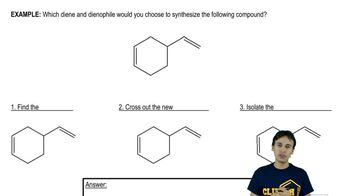
Diels-Alder Retrosynthesis

Electron-Withdrawing Substituents

Electron-withdrawing substituents (EWS) are groups that pull electron density away from the rest of the molecule, often through resonance or inductive effects. In the context of a diene, the presence of an EWS can stabilize the diene's conjugated system, making it less nucleophilic and thus less reactive in a Diels–Alder reaction. This can lead to a slower reaction rate.
Recommended video:
Guided course
04:29
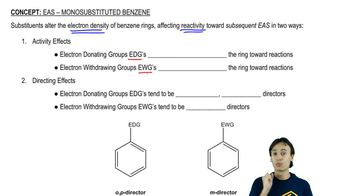
Activity and Directing Effects

Reactivity of Dienes

The reactivity of dienes in Diels–Alder reactions is significantly influenced by their electronic characteristics. Dienes that are electron-rich are more reactive towards electron-deficient dienophiles, while electron-poor dienes are less reactive. Therefore, the introduction of an electron-withdrawing substituent in the diene decreases its reactivity, affecting the overall rate of the reaction.
Recommended video:
Guided course
04:43
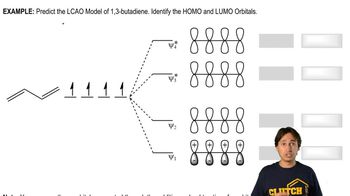
Drawing MO Diagram for Dienes