Ch. 6 - The Reactions of Alkenes • The Stereochemistry of Addition Reactions
Bruice - Organic Chemistry 8th Edition
Bruice8th EditionOrganic ChemistryISBN: 9780135213711Not the one you use?Change textbook
Chapter 7, Problem 14d

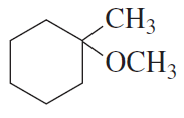
How could the following compounds be prepared using an alkene as one of the starting materials?
d. Chemical structure of a cyclohexane with a methyl group (CH3) and an alkoxy group (OCH3) attached.

Verified step by step guidance
1
Step 1: Analyze the target molecule. The compound is a substituted cyclohexane with two ethyl groups attached to the ring: one as an ethyl group (-CH2CH3) and the other as an ethoxy group (-OCH2CH3). This suggests that the synthesis involves functional group addition to a cyclohexane ring.
Step 2: Identify the alkene precursor. To prepare this compound, the starting material could be a cyclohexene (a six-membered ring with one double bond). The double bond in the cyclohexene will serve as the reactive site for functionalization.
Step 3: Introduce the ethyl group (-CH2CH3). Perform hydroalkylation or alkylation using ethyl bromide (C2H5Br) and a catalyst such as AlCl3. This reaction will add the ethyl group to the cyclohexane ring.
Step 4: Add the ethoxy group (-OCH2CH3). Use an electrophilic addition reaction with ethyl alcohol (C2H5OH) in the presence of an acid catalyst (e.g., H2SO4). This will convert the double bond into an ethoxy-substituted cyclohexane.
Step 5: Verify stereochemistry and regioselectivity. Ensure that the reactions proceed with the correct orientation of substituents on the cyclohexane ring. If necessary, use specific reaction conditions to control the placement of the groups.

Verified video answer for a similar problem:

This video solution was recommended by our tutors as helpful for the problem above.
Video duration:
3m
Was this helpful?

Key Concepts

Here are the essential concepts you must grasp in order to answer the question correctly.

Alkene Reactivity

Alkenes are unsaturated hydrocarbons characterized by at least one carbon-carbon double bond. Their reactivity is primarily due to this double bond, which can undergo various reactions such as electrophilic addition, polymerization, and oxidation. Understanding how alkenes react is crucial for synthesizing complex organic compounds, including ethers, from simpler starting materials.
Recommended video:
2:09
Alkene Metathesis Concept 1

Ether Synthesis

Ethers are organic compounds containing an oxygen atom bonded to two alkyl or aryl groups. They can be synthesized from alkenes through reactions such as the acid-catalyzed addition of alcohols to alkenes or via the Williamson ether synthesis, which involves the nucleophilic substitution of an alkoxide ion. Recognizing these pathways is essential for preparing ethers from alkenes.
Recommended video:
Guided course
03:50
The Mechanism of Williamson Ether Synthesis.

Markovnikov's Rule

Markovnikov's Rule states that in the addition of HX to an alkene, the hydrogen atom will attach to the carbon with the greater number of hydrogen atoms already attached, while the halide (or other substituent) will attach to the carbon with fewer hydrogen atoms. This principle is important for predicting the regioselectivity of reactions involving alkenes, particularly when forming products like ethers.
Recommended video:
Guided course
03:54
The 18 and 16 Electron Rule