Ch. 6 - The Reactions of Alkenes • The Stereochemistry of Addition Reactions
Bruice - Organic Chemistry 8th Edition
Bruice8th EditionOrganic ChemistryISBN: 9780135213711Not the one you use?Change textbook
Chapter 7, Problem 14b

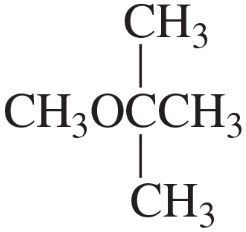
How could the following compounds be prepared using an alkene as one of the starting materials?
b.

Verified step by step guidance
1
Identify the target compound: The given compound is an ether with the structure CH₃OCH(CH₃)₂. This suggests that the preparation involves forming an ether bond (C-O-C) using an alkene as one of the starting materials.
Select an appropriate alkene: To prepare this compound, the alkene should provide the carbon skeleton of the isopropyl group (CH(CH₃)₂). A suitable alkene would be propene (CH₃-CH=CH₂).
Determine the reaction mechanism: The synthesis of ethers can be achieved through the reaction of an alcohol with an alkene in the presence of an acid catalyst. This is known as the acid-catalyzed addition of alcohols to alkenes.
Outline the reaction steps: In the presence of an acid catalyst (e.g., H₂SO₄), the alkene undergoes electrophilic addition. The double bond in propene is protonated to form a carbocation intermediate. The alcohol (methanol, CH₃OH) then attacks the carbocation, forming the ether bond.
Consider regioselectivity: The reaction follows Markovnikov's rule, where the alcohol adds to the more substituted carbon of the alkene. This ensures that the final product is CH₃OCH(CH₃)₂.

Verified video answer for a similar problem:

This video solution was recommended by our tutors as helpful for the problem above.
Video duration:
5m
Was this helpful?

Key Concepts

Here are the essential concepts you must grasp in order to answer the question correctly.

Alkene Reactivity

Alkenes are unsaturated hydrocarbons characterized by at least one carbon-carbon double bond. Their reactivity is primarily due to this double bond, which can undergo various reactions such as electrophilic addition, oxidation, and polymerization. Understanding the types of reactions that alkenes can participate in is crucial for determining how to synthesize other compounds from them.
Recommended video:
2:09
Alkene Metathesis Concept 1

Electrophilic Addition Reactions

Electrophilic addition is a fundamental reaction mechanism for alkenes, where an electrophile reacts with the electron-rich double bond. This process typically involves the formation of a carbocation intermediate, which can lead to the addition of various nucleophiles. Mastery of this concept allows chemists to predict the products formed when alkenes react with different reagents, facilitating the synthesis of desired compounds.
Recommended video:
Guided course
05:39
Features of Addition Mechanisms.

Synthesis Strategies

Synthesis strategies in organic chemistry involve planning a series of chemical reactions to construct a target molecule from simpler starting materials. This includes selecting appropriate reagents and reaction conditions to achieve the desired transformations. A solid understanding of functional group transformations and reaction pathways is essential for effectively designing a synthesis route that incorporates alkenes as starting materials.
Recommended video:
1:16
Synthesis of Amino Acids: Strecker Synthesis Example 1