Ch. 6 - The Reactions of Alkenes • The Stereochemistry of Addition Reactions
Bruice - Organic Chemistry 8th Edition
Bruice8th EditionOrganic ChemistryISBN: 9780135213711Not the one you use?Change textbook
Chapter 7, Problem 14a

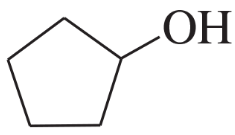
How could the following compounds be prepared using an alkene as one of the starting materials?
a.

Verified step by step guidance
1
Step 1: Identify the target compound. The given compound is cyclopentanol, which contains a cyclopentane ring with a hydroxyl (-OH) group attached.
Step 2: Recognize that the preparation involves using an alkene as one of the starting materials. Cyclopentene, an alkene with a double bond in the cyclopentane ring, is a suitable starting material.
Step 3: Determine the reaction type needed to convert the alkene to an alcohol. The addition of water (H₂O) across the double bond in the presence of an acid catalyst (acid-catalyzed hydration) is a common method to achieve this transformation.
Step 4: Write the reaction mechanism. In acid-catalyzed hydration, the alkene undergoes protonation to form a carbocation intermediate, followed by nucleophilic attack by water, and finally deprotonation to yield the alcohol.
Step 5: Consider regioselectivity and stereochemistry. Since cyclopentene is a symmetrical molecule, the hydroxyl group will add to either side of the double bond without regioselectivity concerns. The product will be cyclopentanol.

Verified video answer for a similar problem:

This video solution was recommended by our tutors as helpful for the problem above.
Video duration:
1m
Was this helpful?

Key Concepts

Here are the essential concepts you must grasp in order to answer the question correctly.

Alkene Reactivity

Alkenes are unsaturated hydrocarbons characterized by at least one carbon-carbon double bond. This double bond makes them highly reactive, allowing them to undergo various reactions such as electrophilic addition, polymerization, and oxidation. Understanding the reactivity of alkenes is crucial for predicting the products formed when they are used as starting materials in organic synthesis.
Recommended video:
2:09
Alkene Metathesis Concept 1

Electrophilic Addition Reactions

Electrophilic addition reactions involve the addition of electrophiles to the double bond of alkenes, resulting in the formation of more saturated compounds. Common electrophiles include halogens, hydrogen halides, and water. Mastery of these reactions is essential for transforming alkenes into desired products, as they dictate the types of functional groups that can be introduced during synthesis.
Recommended video:
Guided course
05:39
Features of Addition Mechanisms.

Stereochemistry

Stereochemistry refers to the spatial arrangement of atoms in molecules and how this affects their chemical properties and reactions. When alkenes undergo reactions, the formation of stereoisomers can occur, leading to different products based on the orientation of substituents around the double bond. Understanding stereochemistry is vital for predicting the outcome of reactions and the properties of the resulting compounds.
Recommended video:
1:38
Polymer Stereochemistry Concept 1