Ch. 6 - The Reactions of Alkenes • The Stereochemistry of Addition Reactions
Bruice - Organic Chemistry 8th Edition
Bruice8th EditionOrganic ChemistryISBN: 9780135213711Not the one you use?Change textbook
Chapter 7, Problem 12a(3,4)

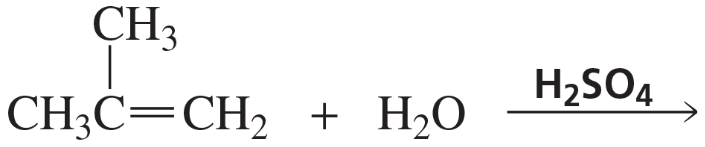
What is the major product of each of the following reactions?
3.
4.

Verified step by step guidance
1
Step 1: Analyze the reaction conditions. Both reactions involve an alkene (CH3C=CH2) reacting with a nucleophile (H2O or CH3OH) in the presence of H2SO4, which acts as an acid catalyst. This suggests an electrophilic addition mechanism.
Step 2: Identify the electrophile and nucleophile. In the presence of H2SO4, the alkene undergoes protonation to form a carbocation intermediate. The nucleophile (H2O or CH3OH) will then attack the carbocation.
Step 3: Determine the carbocation stability. Protonation of the alkene will occur at the less substituted carbon to form the more stable carbocation. In this case, the carbocation forms at the tertiary carbon (CH3C+CH3) due to its greater stability compared to a secondary carbocation.
Step 4: Nucleophilic attack. In the first reaction, H2O acts as the nucleophile and attacks the carbocation, leading to the formation of an alcohol. In the second reaction, CH3OH acts as the nucleophile and attacks the carbocation, leading to the formation of an ether.
Step 5: Final product formation. After the nucleophilic attack, a proton transfer occurs to regenerate the acid catalyst (H2SO4), resulting in the final product. For the first reaction, the major product is an alcohol. For the second reaction, the major product is an ether.

Verified video answer for a similar problem:

This video solution was recommended by our tutors as helpful for the problem above.
Video duration:
5m
Was this helpful?

Key Concepts

Here are the essential concepts you must grasp in order to answer the question correctly.

Reaction Mechanisms

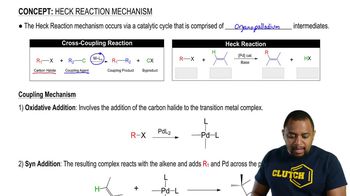
Understanding reaction mechanisms is crucial in organic chemistry as they describe the step-by-step process by which reactants transform into products. This includes identifying intermediates, transition states, and the movement of electrons. Knowledge of mechanisms helps predict the major products of reactions based on the stability of intermediates and the energy changes involved.
Recommended video:
Guided course
02:16
Heck Reaction Mechanism

Functional Groups

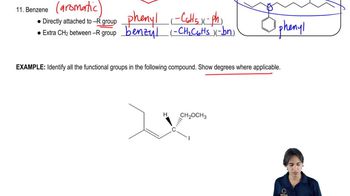
Functional groups are specific groups of atoms within molecules that are responsible for the characteristic chemical reactions of those molecules. Recognizing functional groups allows chemists to predict how different compounds will react under various conditions. This is essential for determining the major products of reactions, as the reactivity often depends on the presence and type of functional groups.
Recommended video:
Guided course
02:36
Identifying Functional Groups

Regioselectivity and Stereoselectivity

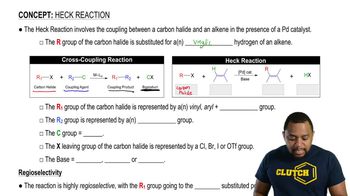
Regioselectivity refers to the preference of a chemical reaction to yield one structural isomer over others, while stereoselectivity involves the preference for one stereoisomer over another. These concepts are important for predicting the major product in reactions, especially in cases where multiple products are possible. Understanding these principles helps in analyzing the outcomes of reactions based on the orientation of reactants and the nature of the reaction conditions.
Recommended video:
Guided course
05:09
Heck Reaction