Ch. 6 - The Reactions of Alkenes • The Stereochemistry of Addition Reactions
Bruice - Organic Chemistry 8th Edition
Bruice8th EditionOrganic ChemistryISBN: 9780135213711Not the one you use?Change textbook
Chapter 7, Problem 15

Propose a mechanism for the following reaction (remember to use curved arrows to show the movement of electrons from the nucleophile to the electrophile):
Chemical reaction showing the formation of an ether from an alcohol and an alkene, with sulfuric acid as a catalyst.

Verified step by step guidance
1
Identify the nucleophile and electrophile in the reaction. The nucleophile is the species donating a pair of electrons, while the electrophile is the species accepting the electrons. Look for lone pairs, π-bonds, or negative charges on the nucleophile and partial positive charges or electron-deficient atoms on the electrophile.
Draw the first step of the mechanism. Use a curved arrow to show the movement of electrons from the nucleophile to the electrophile. For example, if the nucleophile has a lone pair, draw an arrow from the lone pair to the electrophilic atom.
Account for any leaving group. If the electrophile has a leaving group (e.g., a halide ion or a tosylate group), show the bond between the electrophile and the leaving group breaking. Use a curved arrow to indicate the electrons moving onto the leaving group, forming a lone pair.
Continue the mechanism step by step. If the reaction involves intermediates (e.g., carbocations, enolates, or radicals), draw each intermediate and show how the reaction proceeds to the next step. Use curved arrows to indicate electron movement at each stage.
Verify the final product. Ensure that all atoms have the correct number of bonds and formal charges. Confirm that the mechanism aligns with the reaction conditions and the expected product.

Verified video answer for a similar problem:

This video solution was recommended by our tutors as helpful for the problem above.
Video duration:
5m
Was this helpful?

Key Concepts

Here are the essential concepts you must grasp in order to answer the question correctly.

Nucleophiles and Electrophiles

Nucleophiles are species that donate an electron pair to form a chemical bond, typically possessing a negative charge or a lone pair of electrons. Electrophiles, on the other hand, are electron-deficient species that accept electron pairs, often carrying a positive charge or being polarizable. Understanding the roles of these species is crucial for predicting the outcome of organic reactions.
Recommended video:
Guided course
03:
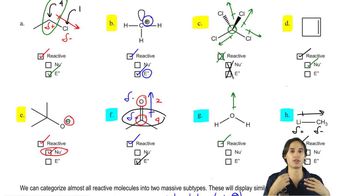
Nucleophile or Electrophile

Curved Arrows in Mechanisms

Curved arrows are a notation used in organic chemistry to illustrate the movement of electrons during a reaction mechanism. The tail of the arrow indicates the electron source (nucleophile), while the head points to the electron sink (electrophile). This visual representation helps clarify how bonds are formed and broken, making it essential for accurately depicting reaction pathways.
Recommended video:
Guided course
04:32
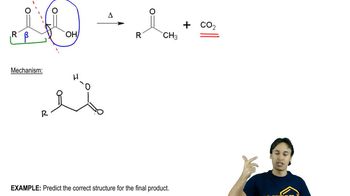
General Mechanism

Reaction Mechanisms

A reaction mechanism is a step-by-step description of the process by which reactants transform into products. It outlines the sequence of bond-breaking and bond-forming events, often involving intermediates and transition states. Understanding mechanisms is vital for predicting reaction outcomes, optimizing conditions, and designing new synthetic pathways in organic chemistry.
Recommended video:
Guided course
02:16
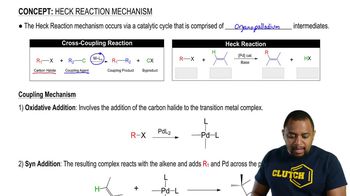
Heck Reaction Mechanism