Ch. 21 - Amino Acids, Peptides, and Proteins
Bruice - Organic Chemistry 8th Edition
Bruice8th EditionOrganic ChemistryISBN: 9780135213711Not the one you use?Change textbook
Chapter 22, Problem 73

Write the mechanism for the reaction of an amino acid with di-tert-butyl dicarbonate.

Verified step by step guidance
1
Identify the functional groups in the amino acid: The amino acid contains an amine group (-NH2) and a carboxylic acid group (-COOH). The reaction will involve the amine group reacting with di-tert-butyl dicarbonate (Boc2O).
Understand the role of di-tert-butyl dicarbonate: Boc2O is a reagent used to protect the amine group by converting it into a Boc-protected amine. This reaction prevents the amine group from participating in further reactions.
Initiate the reaction: The lone pair of electrons on the nitrogen atom in the amine group attacks one of the carbonyl carbons in Boc2O. This is a nucleophilic attack, as the nitrogen acts as a nucleophile and the carbonyl carbon is electrophilic.
Form the tetrahedral intermediate: The nucleophilic attack results in the formation of a tetrahedral intermediate. One of the tert-butyl carbonate groups is displaced as a leaving group during this step.
Complete the reaction: The intermediate collapses, leading to the formation of the Boc-protected amine. The final product is the amino acid with its amine group protected as an N-Boc derivative, and tert-butanol is released as a byproduct.

Verified video answer for a similar problem:

This video solution was recommended by our tutors as helpful for the problem above.
Video duration:
5m
Was this helpful?

Key Concepts

Here are the essential concepts you must grasp in order to answer the question correctly.

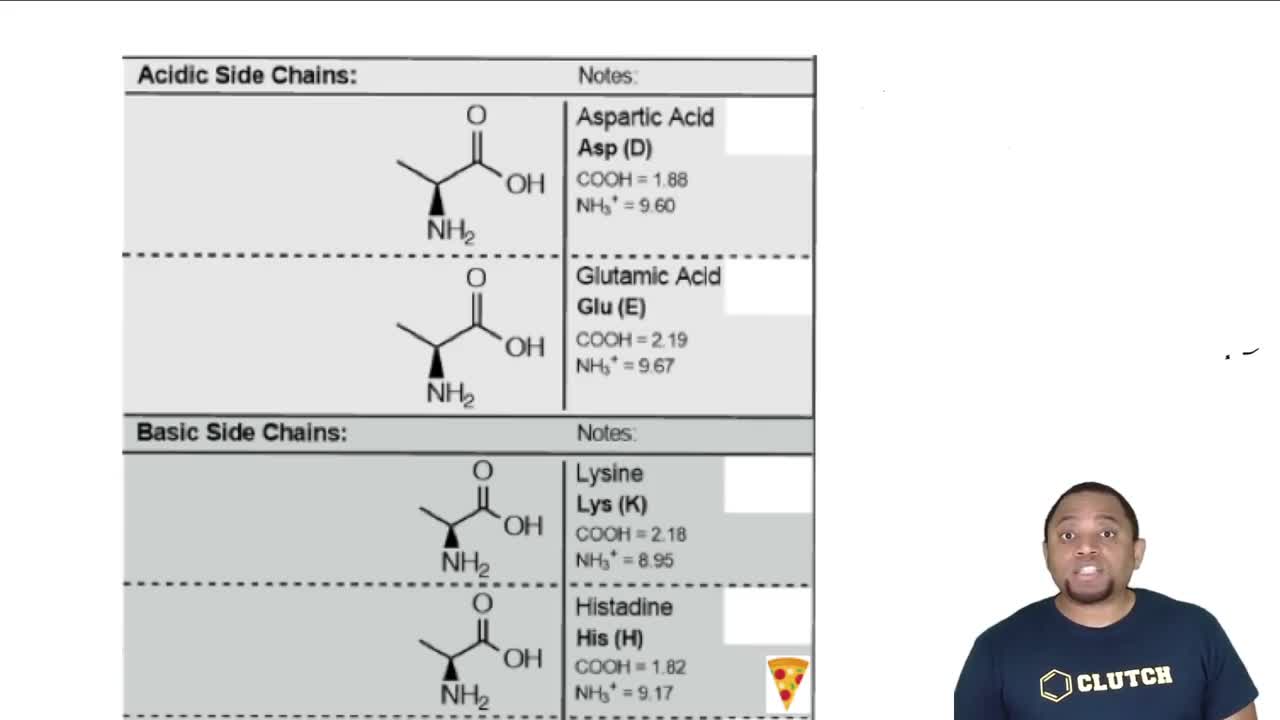
Amino Acid Structure

Amino acids are organic compounds that serve as the building blocks of proteins. They consist of a central carbon atom bonded to an amino group (-NH2), a carboxyl group (-COOH), a hydrogen atom, and a variable R group that determines the specific properties of each amino acid. Understanding the structure of amino acids is crucial for analyzing their reactivity and interactions with other chemical species.
Recommended video:
Guided course
11:14
Charged Amino Acids

Protecting Groups in Organic Synthesis

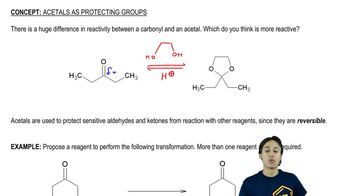
Protecting groups are temporary modifications used in organic synthesis to prevent certain functional groups from reacting during a chemical reaction. In the case of di-tert-butyl dicarbonate (Boc2O), it acts as a protecting group for the amino group of an amino acid, allowing for selective reactions without interference from the amine. This concept is essential for controlling the reactivity of functional groups in complex organic transformations.
Recommended video:
Guided course
02:44
Protecting Groups

Mechanism of Nucleophilic Acyl Substitution

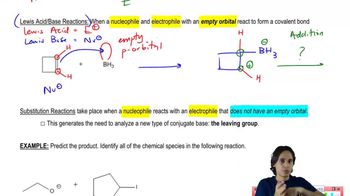
The reaction between an amino acid and di-tert-butyl dicarbonate involves nucleophilic acyl substitution, where the nucleophilic amino group attacks the electrophilic carbonyl carbon of the dicarbonate. This mechanism typically includes the formation of a tetrahedral intermediate, followed by the elimination of a leaving group. Understanding this mechanism is vital for predicting the outcome of the reaction and the stability of the resulting products.
Recommended video:
Guided course
01:47
Nucleophiles and Electrophiles can react in Substitution Reactions.