Ch. 21 - Amino Acids, Peptides, and Proteins
Bruice - Organic Chemistry 8th Edition
Bruice8th EditionOrganic ChemistryISBN: 9780135213711Not the one you use?Change textbook
Chapter 22, Problem 75a

Show how valine can be prepared by
a. a Hell–Volhard–Zelinski reaction.

Verified step by step guidance
1
Step 1: Begin by identifying the starting material for the synthesis of valine. Valine is an α-amino acid with a branched alkyl side chain. To prepare valine using the Hell–Volhard–Zelinski (HVZ) reaction, start with a carboxylic acid that has the appropriate carbon skeleton, such as isobutyric acid (CH₃CH(CH₃)COOH).
Step 2: Apply the Hell–Volhard–Zelinski reaction to the carboxylic acid. This reaction involves treating the carboxylic acid with bromine (Br₂) in the presence of phosphorus tribromide (PBr₃). This step selectively brominates the α-carbon of the carboxylic acid, forming an α-bromo acid. The reaction mechanism includes the formation of an acyl bromide intermediate, which facilitates α-bromination.
Step 3: Convert the α-bromo acid into an α-amino acid. This is achieved by nucleophilic substitution, where ammonia (NH₃) is used to replace the bromine atom with an amino group (-NH₂). The reaction proceeds via an SN2 mechanism, resulting in the formation of valine.
Step 4: Purify the product. After the substitution reaction, the crude mixture may contain unreacted starting materials and byproducts. Use techniques such as recrystallization or chromatography to isolate and purify valine.
Step 5: Verify the structure and purity of valine. Use spectroscopic methods such as NMR (nuclear magnetic resonance) and IR (infrared spectroscopy) to confirm the presence of the amino group and the carboxylic acid functional group, as well as the correct branching in the side chain.

Verified video answer for a similar problem:

This video solution was recommended by our tutors as helpful for the problem above.
Was this helpful?

Key Concepts

Here are the essential concepts you must grasp in order to answer the question correctly.

Hell–Volhard–Zelinski Reaction

The Hell–Volhard–Zelinski (HVZ) reaction is a method for the halogenation of carboxylic acids at the alpha position. This reaction involves the formation of an acyl halide from the carboxylic acid, followed by halogenation at the alpha carbon using a halogen and a base. It is particularly useful for synthesizing alpha-halo acids, which can be further transformed into amino acids like valine.
Recommended video:
Guided course
05:09
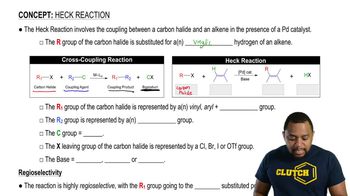
Heck Reaction

Alpha-Amino Acids

Alpha-amino acids are organic compounds that contain both an amino group (-NH2) and a carboxyl group (-COOH) attached to the same carbon atom, known as the alpha carbon. Valine, an essential branched-chain amino acid, is one such compound. Understanding the structure and properties of alpha-amino acids is crucial for grasping how they can be synthesized and modified in organic chemistry.
Recommended video:
Guided course
09:36
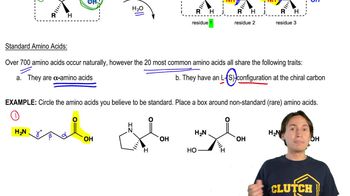
Standard Amino Acids

Synthesis of Valine

Valine can be synthesized through various methods, including the HVZ reaction, which allows for the introduction of a halogen at the alpha position of a carboxylic acid. Following the halogenation, further reactions such as hydrolysis and amination can convert the halogenated compound into valine. Familiarity with these synthetic pathways is essential for understanding how to prepare specific amino acids in organic chemistry.
Recommended video:
1:16
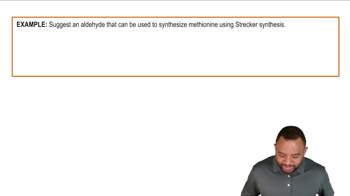
Synthesis of Amino Acids: Strecker Synthesis Example 1