Write the mechanism for the reaction of an amino acid with di-tert-butyl dicarbonate.
Ch. 21 - Amino Acids, Peptides, and Proteins
Chapter 22, Problem 74
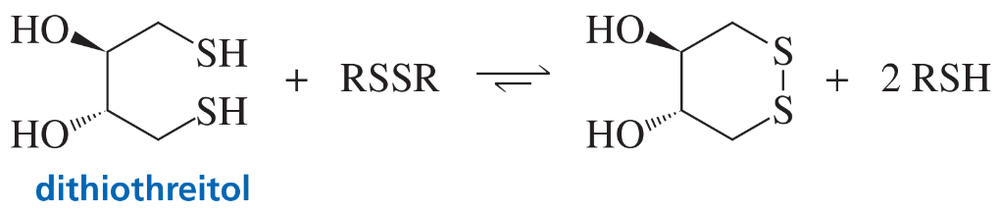
Dithiothreitol reacts with disulfide bridges in the same way that 2-mercaptoethanol does. With dithiothreitol, however, the equilibrium lies much more to the right. Explain.

Verified step by step guidance1
Dithiothreitol (DTT) contains two thiol (-SH) groups that can react with disulfide bridges (RSSR) in proteins or other molecules. The reaction involves the reduction of the disulfide bond to two thiol groups (RSH) while DTT itself forms a cyclic disulfide.
The equilibrium of this reaction lies more to the right (favoring the products) because the formation of the cyclic disulfide in DTT is highly thermodynamically favorable. This is due to the stability of the five-membered ring formed in the product.
The five-membered ring in the oxidized form of DTT is stabilized by its geometry and intramolecular interactions, which lowers the energy of the product and shifts the equilibrium toward the right.
In contrast, 2-mercaptoethanol does not form a cyclic disulfide upon oxidation. Instead, it forms a linear disulfide, which is less stable compared to the cyclic disulfide of DTT. This makes the equilibrium for 2-mercaptoethanol less favorable toward the products.
Thus, the higher thermodynamic stability of the cyclic disulfide product in DTT explains why the equilibrium lies much more to the right compared to 2-mercaptoethanol.

Verified video answer for a similar problem:
This video solution was recommended by our tutors as helpful for the problem above.
Video duration:
6mWas this helpful?
Key Concepts
Here are the essential concepts you must grasp in order to answer the question correctly.
Disulfide Bridges
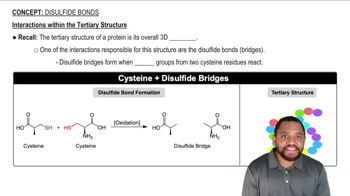
Disulfide bridges are covalent bonds formed between the sulfur atoms of two cysteine residues in proteins. These bonds play a crucial role in stabilizing the three-dimensional structure of proteins. The reduction of disulfide bridges can lead to the unfolding of proteins, affecting their function.
Recommended video:
Disulfide Bonds Concept 2
Reducing Agents
Reducing agents are substances that donate electrons to other compounds, thereby reducing their oxidation state. In the context of disulfide bridges, reducing agents like dithiothreitol (DTT) and 2-mercaptoethanol break these bonds by providing electrons, converting disulfides back to free thiols. The effectiveness of a reducing agent is often determined by its ability to shift the equilibrium of the reaction.
Recommended video:
Guided course
Reducing Agents
Equilibrium in Chemical Reactions
Equilibrium in chemical reactions refers to the state where the rates of the forward and reverse reactions are equal, resulting in constant concentrations of reactants and products. In the case of DTT, its ability to shift the equilibrium further to the right indicates a stronger tendency to reduce disulfide bridges compared to 2-mercaptoethanol, making it a more effective reducing agent in biological systems.
Recommended video:
Chemical Reactions of Phosphate Anhydrides Concept 1
Related Practice
Textbook Question
1
views
Textbook Question
Glycine has pKa values of 2.3 and 9.6. Do you expect the pKa values of glycylglycine to be higher or lower than these values?
3
views
Textbook Question
Show how valine can be prepared by
d. a N-phthalimidomalonic ester synthesis.
2
views
Textbook Question
Show how valine can be prepared by
c. a reductive amination.
1
views
Textbook Question
Reaction of a polypeptide with carboxypeptidase A releases Met. The polypeptide undergoes partial hydrolysis to give the following peptides. What is the sequence of the polypeptide?
1. Ser, Lys, Trp
2. Gly, His, Ala
3. Glu, Val, Ser
4. Leu, Glu, Ser
5. Met, Ala, Gly
6. Ser, Lys, Val
7. Glu, His
8. Leu, Lys, Trp
9. Lys, Ser
10. Glu, His, Val
11. Trp, Leu, Glu
12. Ala, Met
2
views
Textbook Question
Show how valine can be prepared by
a. a Hell–Volhard–Zelinski reaction.