Ch. 21 - Amino Acids, Peptides, and Proteins
Bruice - Organic Chemistry 8th Edition
Bruice8th EditionOrganic ChemistryISBN: 9780135213711Not the one you use?Change textbook
Chapter 22, Problem 68b,c

α-Amino acids can be prepared by treating an aldehyde with ammonia/trace acid, followed by hydrogen cyanide, followed by acid-catalyzed hydrolysis.
b. What amino acid is formed when the aldehyde that is used is 3-methylbutanal?
c. What aldehyde is needed to prepare isoleucine?

Verified step by step guidance
1
Step 1: Understand the Strecker synthesis process. In this method, an aldehyde reacts with ammonia and trace acid to form an imine intermediate. Hydrogen cyanide then reacts with the imine to form an aminonitrile, which is hydrolyzed under acidic conditions to yield an α-amino acid.
Step 2: For part (b), identify the aldehyde used: 3-methylbutanal. This aldehyde has a branched structure with a methyl group on the third carbon of a butanal chain. The Strecker synthesis will add an amino group (-NH2) and a carboxylic acid group (-COOH) to the α-carbon of the aldehyde, forming the corresponding α-amino acid.
Step 3: Analyze the structure of 3-methylbutanal. The α-carbon of the aldehyde is adjacent to the carbonyl group. After the Strecker synthesis, the α-carbon will have an amino group and a carboxylic acid group, resulting in the formation of leucine, an α-amino acid with a branched side chain.
Step 4: For part (c), determine the aldehyde needed to prepare isoleucine. Isoleucine is an α-amino acid with a specific branched structure. To synthesize isoleucine via the Strecker synthesis, the aldehyde must have a structure that, after the addition of the amino and carboxylic acid groups, matches the side chain of isoleucine. The required aldehyde is 2-methylbutanal.
Step 5: Summarize the process. For part (b), 3-methylbutanal leads to leucine. For part (c), 2-methylbutanal is the aldehyde needed to prepare isoleucine. Both follow the Strecker synthesis mechanism, which involves imine formation, aminonitrile formation, and acid-catalyzed hydrolysis.

Verified video answer for a similar problem:

This video solution was recommended by our tutors as helpful for the problem above.
Video duration:
4m
Was this helpful?

Key Concepts

Here are the essential concepts you must grasp in order to answer the question correctly.

Amino Acid Structure

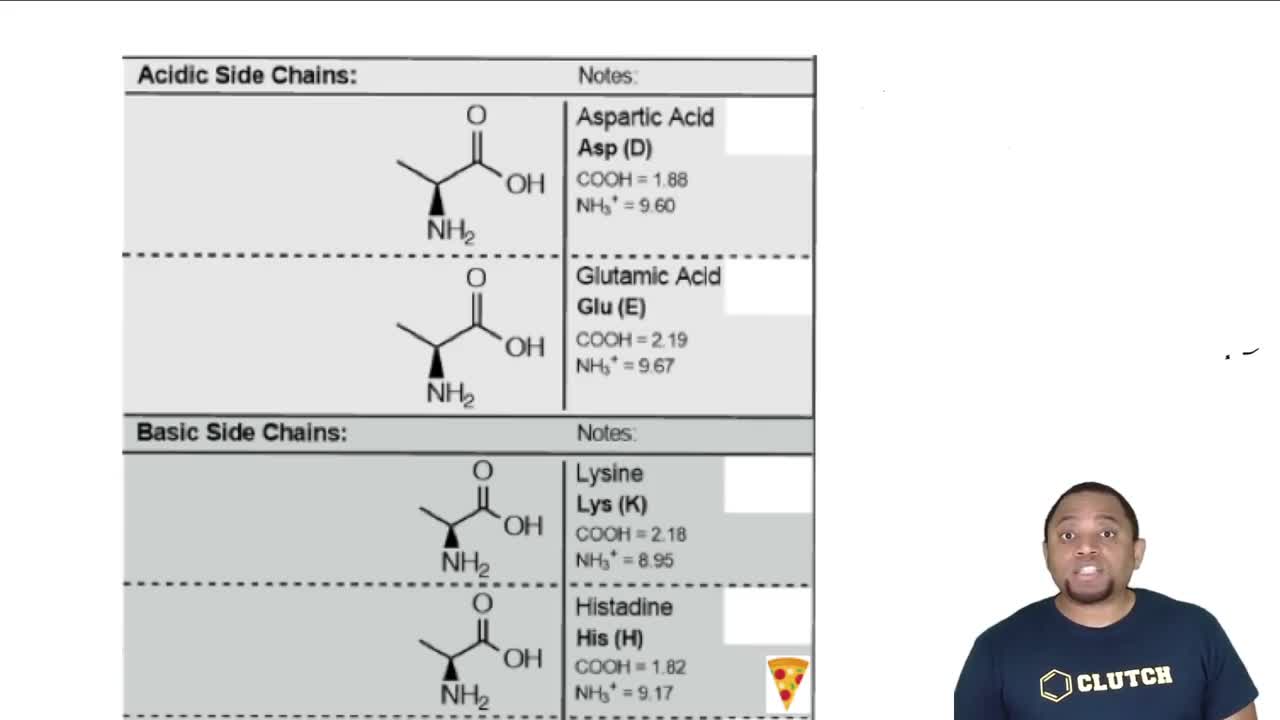
Amino acids are organic compounds characterized by the presence of an amino group (-NH2), a carboxyl group (-COOH), and a unique side chain (R group) that determines the properties of the amino acid. The general structure allows for the formation of proteins through peptide bonds, where the carboxyl group of one amino acid reacts with the amino group of another.
Recommended video:
Guided course
11:14
Charged Amino Acids

Aldehyde Reactivity

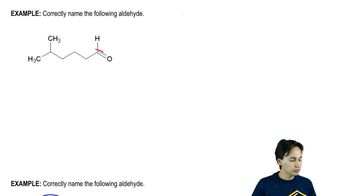
Aldehydes are reactive carbonyl compounds that can undergo nucleophilic addition reactions. In the synthesis of amino acids, aldehydes react with ammonia to form imines, which can then be further processed with hydrogen cyanide and hydrolysis to yield amino acids. The specific aldehyde used influences the structure of the resulting amino acid.
Recommended video:
Guided course
01:34
Name the aldehyde

Synthesis of Isoleucine

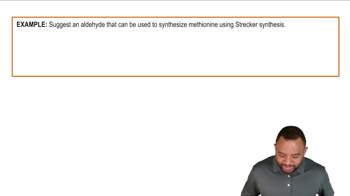
Isoleucine is an essential amino acid that can be synthesized from specific aldehydes through a series of reactions. To prepare isoleucine, the appropriate aldehyde is 2-methylbutanal, which, when treated with ammonia and followed by hydrogen cyanide and hydrolysis, leads to the formation of isoleucine. Understanding the correct precursor is crucial for successful synthesis.
Recommended video:
1:16
Synthesis of Amino Acids: Strecker Synthesis Example 1
Related Practice
Textbook Question

Write the mechanism for the reaction of an amino acid with di-tert-butyl dicarbonate.

1
views

Textbook Question

α-Amino acids can be prepared by treating an aldehyde with ammonia/trace acid, followed by hydrogen cyanide, followed by acid-catalyzed hydrolysis.

a. Draw the structures of the two intermediates formed in this reaction.

1
views
Textbook Question

Glycine has pKa values of 2.3 and 9.6. Do you expect the pKa values of glycylglycine to be higher or lower than these values?

3
views
Textbook Question

After the polypeptide shown below was treated with maleic anhydride, it was hydrolyzed by trypsin. (After a polypeptide is treated with maleic anhy- dride, trypsin will cleave the polypeptide only on the C-side of arginine.)

Gly-Ala-Asp-Ala-Leu-Pro-Gly-Ile-Leu-Val-Arg-Asp-Val-Gly-Lys-Val-Glu-Val-Phe-Glu-Ala-Gly- Arg-Ala-Glu-Phe-Lys-Glu-Pro-Arg-Leu-Val-Met-Lys-Val-Glu-Gly-Arg-Pro-Val-Gly-Ala-Gly-Leu-Trp

a. After a polypeptide is treated with maleic anhydride, why does trypsin no longer cleave it on the C-side of lysine?

b. How many fragments are obtained from the polypeptide?

2
views
Textbook Question

Reaction of a polypeptide with carboxypeptidase A releases Met. The polypeptide undergoes partial hydrolysis to give the following peptides. What is the sequence of the polypeptide?

1. Ser, Lys, Trp

2. Gly, His, Ala

3. Glu, Val, Ser

4. Leu, Glu, Ser

5. Met, Ala, Gly

6. Ser, Lys, Val

7. Glu, His

8. Leu, Lys, Trp

9. Lys, Ser

10. Glu, His, Val

11. Trp, Leu, Glu

12. Ala, Met

2
views
Textbook Question

Draw the product obtained when a lysine side chain in a polypeptide reacts with maleic anhydride.

1
views