Ch. 2 - Acids and Bases: Central to Understanding Organic Chemistry
Bruice - Organic Chemistry 8th Edition
Bruice8th EditionOrganic ChemistryISBN: 9780135213711Not the one you use?Change textbook
Chapter 3, Problem 52e,f

What products are formed when each of the following reacts with HO?
e. +CH3
f. FeBr3

Verified step by step guidance
1
Step 1: For part (e), consider the reaction of the methyl cation (+CH3) with hydroxide ion (HO−). The methyl cation is a highly reactive electrophile, and the hydroxide ion is a strong nucleophile. Analyze the nucleophilic attack of HO− on the positively charged carbon of +CH3.
Step 2: Write the reaction mechanism for part (e). The hydroxide ion donates a lone pair of electrons to the carbon atom of +CH3, forming a new C-O bond. This results in the formation of methanol (CH3OH).
Step 3: For part (f), consider the reaction of FeBr3 with hydroxide ion (HO−). FeBr3 is a Lewis acid, and hydroxide ion is a strong base. Analyze the acid-base interaction between FeBr3 and HO−.
Step 4: Write the reaction mechanism for part (f). The hydroxide ion reacts with FeBr3, leading to the formation of a ferric hydroxide complex (Fe(OH)3) and bromide ions (Br−).
Step 5: Summarize the products for both reactions. For part (e), the product is methanol (CH3OH). For part (f), the products are Fe(OH)3 and Br−. Ensure the reaction mechanisms are balanced and consistent with the principles of organic and inorganic chemistry.

Verified video answer for a similar problem:

This video solution was recommended by our tutors as helpful for the problem above.
Video duration:
5m
Was this helpful?

Key Concepts

Here are the essential concepts you must grasp in order to answer the question correctly.

Nucleophilic Attack

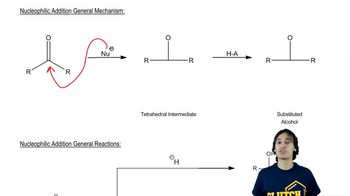
Nucleophilic attack is a fundamental reaction mechanism in organic chemistry where a nucleophile, such as hydroxide ion (HO−), donates a pair of electrons to an electrophile, forming a new bond. Understanding this concept is crucial for predicting the products of reactions, as it determines how reactants interact and what new compounds are formed.
Recommended video:
Guided course
08:27
Nucleophilic Addition

Electrophiles

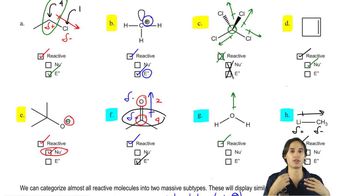
Electrophiles are species that accept electron pairs from nucleophiles during chemical reactions. They are typically positively charged or have a partial positive charge, making them attractive to nucleophiles. Identifying the electrophiles in a reaction is essential for determining the products formed when they react with nucleophiles like HO−.
Recommended video:
Guided course
03:
Nucleophile or Electrophile

Reaction Conditions

Reaction conditions, including the presence of solvents, temperature, and catalysts, significantly influence the outcome of chemical reactions. In the context of the question, understanding how HO− interacts with different reactants under specific conditions helps predict the nature of the products formed, such as whether substitution or elimination reactions occur.
Recommended video:
1:18
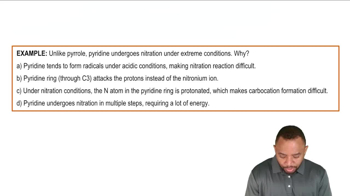
EAS Reactions of Pyridine Example 1