Ch. 2 - Acids and Bases: Central to Understanding Organic Chemistry
Bruice - Organic Chemistry 8th Edition
Bruice8th EditionOrganic ChemistryISBN: 9780135213711Not the one you use?Change textbook
Chapter 3, Problem 56b,c

b. How does the presence of an electronegative substituent such as Cl affect the acidity of a carboxylic acid?
c. How does the location of the substituent affect the acidity of the carboxylic acid?
Chemical structures of carboxylic acids with varying acidity constants (Ka) influenced by chlorine substituents.

Verified step by step guidance
1
Step 1: Analyze the effect of an electronegative substituent (like Cl or Br) on acidity. Electronegative atoms withdraw electron density through the inductive effect, stabilizing the conjugate base of the carboxylic acid. This stabilization increases the acid's ability to donate a proton, thereby increasing its acidity.
Step 2: Compare the given Ka values for the acids. A higher Ka value indicates a stronger acid. For example, CH3CH2CHClCOOH (Ka = 1.39×10⁻³) is more acidic than CH3CH2CH2COOH (Ka = 1.52×10⁻⁵) due to the presence of the electronegative Cl substituent.
Step 3: Examine the location of the substituent relative to the carboxylic acid group. The closer the electronegative substituent is to the carboxylic acid group, the stronger the inductive effect, leading to greater stabilization of the conjugate base and increased acidity. For example, 2-bromobutanoic acid is more acidic than 3-bromobutanoic acid, which is more acidic than 4-bromobutanoic acid.
Step 4: Relate the structures in the image to the acidity trend. The acids are arranged in increasing acidity from butyric acid (no electronegative substituent) to 4-bromobutanoic acid, 3-bromobutanoic acid, and finally 2-bromobutanoic acid, where the bromine atom is closest to the carboxylic acid group.
Step 5: Conclude that both the presence of an electronegative substituent and its proximity to the carboxylic acid group significantly affect the acidity of the compound. The inductive effect is stronger when the substituent is closer to the functional group, leading to higher acidity.

Verified video answer for a similar problem:

This video solution was recommended by our tutors as helpful for the problem above.
Video duration:
6m
Was this helpful?

Key Concepts

Here are the essential concepts you must grasp in order to answer the question correctly.

Acidity and pKa

Acidity in organic chemistry is often measured by the acid dissociation constant (Ka), which indicates the strength of an acid in solution. A higher Ka value corresponds to a stronger acid, while a lower pKa (the negative logarithm of Ka) indicates greater acidity. Carboxylic acids, such as butyric acid, can have their acidity influenced by substituents that either stabilize or destabilize the carboxylate ion formed upon deprotonation.
Recommended video:
Guided course
07:45
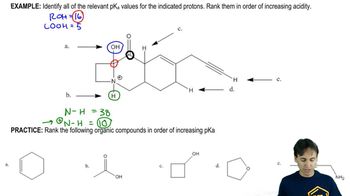
Identifying pKa values

Electronegative Substituents

Electronegative substituents, like chlorine (Cl) or bromine (Br), can significantly affect the acidity of carboxylic acids. These substituents can stabilize the negative charge of the carboxylate ion through inductive effects, making the acid more likely to donate a proton. The greater the electronegativity and the closer the substituent is to the carboxylic group, the stronger the acid becomes due to increased stabilization of the conjugate base.
Recommended video:
Guided course
1:47
Electronegativity

Position of Substituents

The position of an electronegative substituent relative to the carboxylic acid group plays a crucial role in determining acidity. Substituents located closer to the carboxyl group exert a stronger inductive effect, enhancing the acid's strength. For example, in the case of brominated butyric acids, the acidity increases as the bromine atom moves closer to the carboxylic group, demonstrating the importance of spatial arrangement in influencing acid strength.
Recommended video:
4:06
Reactions at the Allylic Position Example 3