Ch. 2 - Acids and Bases: Central to Understanding Organic Chemistry
Bruice - Organic Chemistry 8th Edition
Bruice8th EditionOrganic ChemistryISBN: 9780135213711Not the one you use?Change textbook
Chapter 3, Problem 52c,d

What products are formed when each of the following reacts with HO?
c. CH3N+H3
d. BF3

Verified step by step guidance
1
Step 1: Analyze the reaction of CH3N+H3 with HO−. CH3N+H3 is a positively charged ammonium ion, and HO− is a hydroxide ion, which acts as a base. The hydroxide ion will deprotonate the ammonium ion by removing a proton (H+). This is an acid-base reaction.
Step 2: Write the chemical equation for the reaction of CH3N+H3 with HO−. The hydroxide ion will abstract a proton from CH3N+H3, resulting in the formation of CH3NH2 (methylamine) and H2O (water). The equation can be expressed as: CH3N+H3+HOCH3NH2+H2O
Step 3: Analyze the reaction of BF3 with HO−. BF3 is a Lewis acid because boron has an incomplete octet and can accept electron pairs. HO− is a Lewis base because it has a lone pair of electrons. The hydroxide ion will donate its lone pair to boron, forming a coordinate covalent bond.
Step 4: Write the chemical equation for the reaction of BF3 with HO−. The hydroxide ion will bond with BF3, resulting in the formation of a tetrahedral complex, BF3OH−. The equation can be expressed as: BF3+HOBF3OH
Step 5: Summarize the products formed. For CH3N+H3 reacting with HO−, the products are CH3NH2 and H2O. For BF3 reacting with HO−, the product is BF3OH−. These reactions demonstrate acid-base and Lewis acid-base interactions, respectively.

Verified video answer for a similar problem:

This video solution was recommended by our tutors as helpful for the problem above.
Video duration:
5m
Was this helpful?

Key Concepts

Here are the essential concepts you must grasp in order to answer the question correctly.

Nucleophilicity

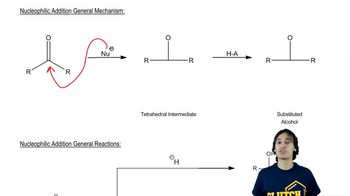
Nucleophilicity refers to the ability of a species to donate an electron pair to form a chemical bond. In the context of the question, HO− (hydroxide ion) acts as a nucleophile, attacking electrophilic centers in the reactants. Understanding which species can act as nucleophiles and how they interact with electrophiles is crucial for predicting the products of the reactions.
Recommended video:
Guided course
08:27
Nucleophilic Addition

Electrophiles

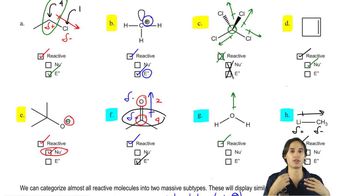
Electrophiles are species that accept electron pairs from nucleophiles during a chemical reaction. In this question, CH3N+H3 (methylammonium ion) and BF3 (boron trifluoride) are both electrophiles. Recognizing the nature of these electrophiles helps in understanding how they will react with the hydroxide ion, leading to the formation of specific products.
Recommended video:
Guided course
03:
Nucleophile or Electrophile

Acid-Base Reactions

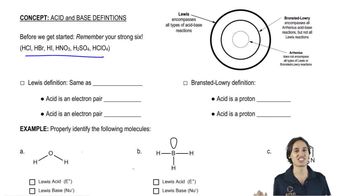
Acid-base reactions involve the transfer of protons (H+) between species. In the case of CH3N+H3, it can act as a Brønsted acid, while HO− acts as a base, leading to the formation of products through proton transfer. For BF3, which is a Lewis acid, it can accept a pair of electrons from HO−, illustrating the broader concept of acid-base interactions in organic chemistry.
Recommended video:
Guided course
02:49
The Lewis definition of acids and bases.