Ch. 2 - Acids and Bases: Central to Understanding Organic Chemistry
Bruice - Organic Chemistry 8th Edition
Bruice8th EditionOrganic ChemistryISBN: 9780135213711Not the one you use?Change textbook
Chapter 3, Problem 52a,b

What products are formed when each of the following reacts with HO?
a. CH3OH
b. +NH4

Verified step by step guidance
1
Step 1: Analyze the reaction of CH3OH (methanol) with HO− (hydroxide ion). Methanol is a weak acid, and hydroxide ion is a strong base. The hydroxide ion can deprotonate the hydroxyl group (-OH) of methanol, forming methoxide ion (CH3O−) and water (H2O). Write the reaction as: CH3OH + HO− → CH3O− + H2O.
Step 2: Consider the reaction of +NH4 (ammonium ion) with HO−. The ammonium ion is a weak acid, and hydroxide ion is a strong base. The hydroxide ion can deprotonate the ammonium ion, forming ammonia (NH3) and water (H2O). Write the reaction as: +NH4 + HO− → NH3 + H2O.
Step 3: For both reactions, identify the acid-base pairs. In the first reaction, CH3OH is the acid, and CH3O− is its conjugate base. In the second reaction, +NH4 is the acid, and NH3 is its conjugate base.
Step 4: Confirm that the reactions proceed in the direction that favors the formation of the weaker acid and base. In both cases, the products (CH3O− and NH3) are weaker bases compared to the reactants (HO−), and the reactions are thermodynamically favorable.
Step 5: Summarize the products formed. For part (a), the products are CH3O− and H2O. For part (b), the products are NH3 and H2O. Ensure the reactions are balanced and consistent with acid-base chemistry principles.

Verified video answer for a similar problem:

This video solution was recommended by our tutors as helpful for the problem above.
Video duration:
4m
Was this helpful?

Key Concepts

Here are the essential concepts you must grasp in order to answer the question correctly.

Nucleophilic Substitution

Nucleophilic substitution is a fundamental reaction in organic chemistry where a nucleophile, such as hydroxide ion (HO−), attacks a carbon atom, replacing a leaving group. In the case of CH3OH (methanol), the hydroxide ion can replace the hydroxyl group, leading to the formation of methoxide ion (CH3O−). Understanding this mechanism is crucial for predicting the products of reactions involving nucleophiles.
Recommended video:
Guided course
01:47
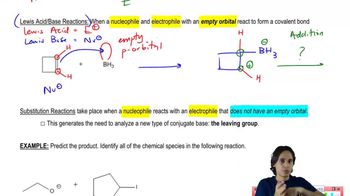
Nucleophiles and Electrophiles can react in Substitution Reactions.

Ammonium Ion Reactivity

The ammonium ion (NH4+) is a positively charged species that can participate in acid-base reactions. When it reacts with HO−, it can undergo deprotonation, resulting in the formation of ammonia (NH3) and water. Recognizing the behavior of ammonium ions in the presence of strong bases is essential for predicting the outcome of such reactions.
Recommended video:
2:18
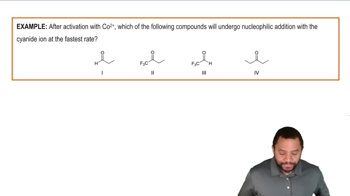
Metal Ion Catalysis Example 1

Acid-Base Reactions

Acid-base reactions involve the transfer of protons (H+) between species. In this context, HO− acts as a strong base, capable of accepting protons from acids like NH4+. Understanding the principles of acid-base chemistry helps in predicting the products formed when different organic compounds interact with hydroxide ions.
Recommended video:
Guided course
02:49
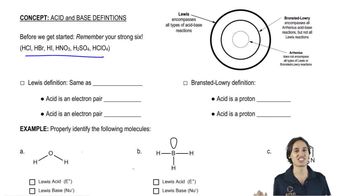
The Lewis definition of acids and bases.