Ch. 2 - Acids and Bases: Central to Understanding Organic Chemistry
Bruice - Organic Chemistry 8th Edition
Bruice8th EditionOrganic ChemistryISBN: 9780135213711Not the one you use?Change textbook
Chapter 3, Problem 60a

For each of the following compounds, draw the form that predominates at pH = 3, pH = 6, pH = 10, and pH = 14:
a. CH3COOH (pKa = 4.8)

Verified step by step guidance
1
Step 1: Understand the relationship between pH and pKa. The Henderson-Hasselbalch equation, \( \text{pH} = \text{pKa} + \log \left( \frac{[\text{A}^-]}{[\text{HA}]} \right) \), helps determine the ratio of the deprotonated form \( [\text{A}^-] \) to the protonated form \( [\text{HA}] \). When \( \text{pH} < \text{pKa} \), the protonated form \( [\text{HA}] \) predominates, and when \( \text{pH} > \text{pKa} \), the deprotonated form \( [\text{A}^-] \) predominates.
Step 2: Analyze the compound CH3COOH (acetic acid). Acetic acid is a weak acid with a \( \text{pKa} = 4.8 \). The protonated form is \( \text{CH}_3\text{COOH} \), and the deprotonated form is \( \text{CH}_3\text{COO}^- \).
Step 3: Determine the predominant form at \( \text{pH} = 3 \). Since \( \text{pH} = 3 \) is less than \( \text{pKa} = 4.8 \), the protonated form \( \text{CH}_3\text{COOH} \) will predominate.
Step 4: Determine the predominant form at \( \text{pH} = 6 \). Since \( \text{pH} = 6 \) is greater than \( \text{pKa} = 4.8 \), the deprotonated form \( \text{CH}_3\text{COO}^- \) will predominate.
Step 5: Determine the predominant forms at \( \text{pH} = 10 \) and \( \text{pH} = 14 \). Both \( \text{pH} = 10 \) and \( \text{pH} = 14 \) are much greater than \( \text{pKa} = 4.8 \), so the deprotonated form \( \text{CH}_3\text{COO}^- \) will predominate in both cases.

Verified video answer for a similar problem:

This video solution was recommended by our tutors as helpful for the problem above.
Video duration:
4m
Was this helpful?

Key Concepts

Here are the essential concepts you must grasp in order to answer the question correctly.

Acid-Base Equilibrium

Acid-base equilibrium refers to the balance between the protonated (acid) and deprotonated (base) forms of a compound in solution. The pKa value indicates the pH at which half of the acid is dissociated. Understanding this equilibrium is crucial for predicting the predominant form of a compound at different pH levels.
Recommended video:
Guided course
04:00
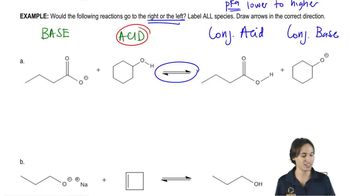
Determining Acid/Base Equilibrium

pH Scale

The pH scale measures the acidity or basicity of a solution, ranging from 0 (very acidic) to 14 (very basic), with 7 being neutral. The pH affects the ionization of acids and bases, influencing their chemical behavior. Knowing the pH of a solution helps determine whether a compound exists primarily in its protonated or deprotonated form.
Recommended video:
Guided course
02:15
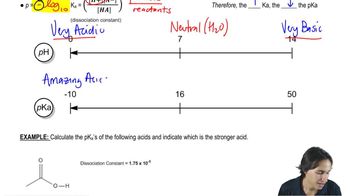
The pH scale vs. the pKa scale.

Dissociation of Acids

Dissociation of acids involves the release of protons (H+) when an acid is dissolved in water. For weak acids like acetic acid (CH3COOH), the extent of dissociation is influenced by the pH of the solution. At pH values below the pKa, the acid predominates, while at pH values above the pKa, the conjugate base becomes more prevalent.
Recommended video:
Guided course
04:09
How to calculate enthalpy using bond dissociation energies.