Ch. 2 - Acids and Bases: Central to Understanding Organic Chemistry
Bruice - Organic Chemistry 8th Edition
Bruice8th EditionOrganic ChemistryISBN: 9780135213711Not the one you use?Change textbook
Chapter 3, Problem 61a

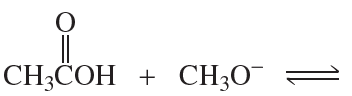
Give the products of the following acid–base reactions and indicate whether reactants or products are favored at equilibrium.
a. Chemical equation showing an acid-base reaction with reactants and products, indicating equilibrium direction.

Verified step by step guidance
1
Identify the acid and base on both sides of the reaction. The acid is the species that donates a proton (H⁺), and the base is the species that accepts a proton.
Determine the conjugate acid and conjugate base formed after the proton transfer. The acid loses a proton to form its conjugate base, and the base gains a proton to form its conjugate acid.
Use the pKa values provided in Section 2.3 to compare the acidity of the acid on the reactant side and the conjugate acid on the product side. Recall that a lower pKa value indicates a stronger acid.
Determine the direction of equilibrium by comparing the strengths of the acids. Equilibrium favors the side with the weaker acid (higher pKa value).
Write the products of the reaction, clearly indicating the conjugate acid and conjugate base, and state whether the equilibrium favors the reactants or products based on the pKa comparison.

Verified video answer for a similar problem:

This video solution was recommended by our tutors as helpful for the problem above.
Video duration:
3m
Was this helpful?

Key Concepts

Here are the essential concepts you must grasp in order to answer the question correctly.

Acid-Base Reactions

Acid-base reactions involve the transfer of protons (H+) between reactants. An acid donates a proton, while a base accepts it. Understanding the nature of the acids and bases involved is crucial for predicting the products of the reaction and determining the direction of equilibrium.
Recommended video:
Guided course
02:49
The Lewis definition of acids and bases.

pKa and Equilibrium

The pKa value is a measure of the strength of an acid; lower pKa values indicate stronger acids. In acid-base reactions, the equilibrium position can be predicted by comparing the pKa values of the acids and their conjugate bases. The reaction favors the side with the weaker acid (higher pKa) at equilibrium.
Recommended video:
Guided course
02:19
The relationship between equilibrium constant and pKa.

Equilibrium Position

The equilibrium position of a reaction indicates the relative concentrations of reactants and products at equilibrium. In acid-base reactions, the favored side is determined by the stability of the resulting species, which is influenced by factors such as electronegativity and resonance. Understanding these concepts helps in predicting the outcome of the reaction.
Recommended video:
2:49
Reactions at the Allylic Position Concept 5