Ch. 2 - Acids and Bases: Central to Understanding Organic Chemistry
Bruice - Organic Chemistry 8th Edition
Bruice8th EditionOrganic ChemistryISBN: 9780135213711Not the one you use?Change textbook
Chapter 3, Problem 60b

For each of the following compounds, draw the form that predominates at pH = 3, pH = 6, pH = 10, and pH = 14:
b. CH3CH2N+H3 (pKa = 11.0)

Verified step by step guidance
1
Step 1: Understand the relationship between pH and pKa. The pKa value indicates the pH at which half of the species is protonated and half is deprotonated. When pH < pKa, the species is predominantly protonated. When pH > pKa, the species is predominantly deprotonated.
Step 2: Analyze the given compound CH3CH2N+H3. This is an ethylammonium ion, which can lose a proton to form CH3CH2NH2. The pKa of the protonated form (CH3CH2N+H3) is given as 11.0.
Step 3: Determine the predominant form at pH=3. Since pH=3 is much lower than the pKa (11.0), the compound will remain fully protonated as CH3CH2N+H3.
Step 4: Determine the predominant form at pH=6. Since pH=6 is still lower than the pKa (11.0), the compound will predominantly remain protonated as CH3CH2N+H3.
Step 5: Determine the predominant forms at pH=10 and pH=14. At pH=10, which is slightly below the pKa, the compound will still be mostly protonated as CH3CH2N+H3, but some deprotonation to CH3CH2NH2 will occur. At pH=14, which is much higher than the pKa, the compound will be fully deprotonated as CH3CH2NH2.

Verified video answer for a similar problem:

This video solution was recommended by our tutors as helpful for the problem above.
Video duration:
6m
Was this helpful?

Key Concepts

Here are the essential concepts you must grasp in order to answer the question correctly.

Acid-Base Chemistry

Acid-base chemistry involves the transfer of protons (H+) between species. The pH of a solution indicates its acidity or basicity, with lower pH values representing acidic conditions and higher values indicating basic conditions. Understanding how acids and bases behave in different pH environments is crucial for predicting the predominant form of a compound.
Recommended video:
Guided course
02:49
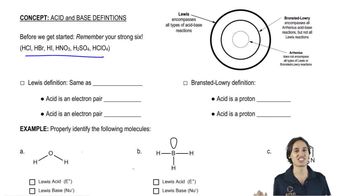
The Lewis definition of acids and bases.

pKa and its Significance

The pKa value is a measure of the strength of an acid in solution, representing the pH at which half of the species are deprotonated. A lower pKa indicates a stronger acid. In this case, with a pKa of 11.0, the compound CH3CH2N+H3 will predominantly exist in its protonated form at lower pH values (like pH 3 and 6) and will start to deprotonate as the pH increases beyond its pKa.
Recommended video:
Guided course
07:45
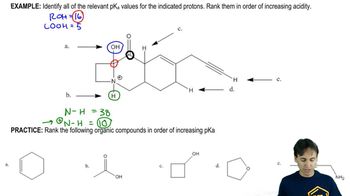
Identifying pKa values

Protonation and Deprotonation

Protonation refers to the addition of a proton (H+) to a molecule, while deprotonation is the removal of a proton. The state of a compound can change based on the pH of the solution; at low pH, compounds are more likely to be protonated, while at high pH, they tend to lose protons. For CH3CH2N+H3, this means it will remain protonated at acidic pH levels and begin to lose protons as the pH rises past its pKa.
Recommended video:
Guided course
03:
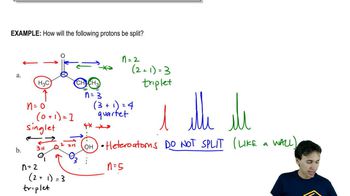
Proton Splitting