Ch. 2 - Acids and Bases: Central to Understanding Organic Chemistry
Bruice - Organic Chemistry 8th Edition
Bruice8th EditionOrganic ChemistryISBN: 9780135213711Not the one you use?Change textbook
Chapter 3, Problem 62a

Rank the following alcohols from strongest to weakest acid.
CH2═CHCH2OH; CH3CH2CH2OH; HC≡CCH2OH

Verified step by step guidance
1
Step 1: Recall that the acidity of alcohols is influenced by the stability of the conjugate base formed after deprotonation. A more stable conjugate base corresponds to a stronger acid.
Step 2: Analyze the conjugate bases of the given alcohols. For CH2═CHCH2OH, the conjugate base is CH2═CHCH2O⁻. The presence of the vinyl group (CH2═CH-) can stabilize the conjugate base through resonance effects.
Step 3: For CH3CH2CH2OH, the conjugate base is CH3CH2CH2O⁻. This is a simple alkoxide ion without any resonance or inductive effects to stabilize it, making it less stable compared to the conjugate base of CH2═CHCH2OH.
Step 4: For HC≡CCH2OH, the conjugate base is HC≡CCH2O⁻. The presence of the alkyne group (HC≡C-) can exert an inductive effect, pulling electron density away from the oxygen atom and stabilizing the conjugate base.
Step 5: Rank the alcohols based on the stability of their conjugate bases: HC≡CCH2OH (strongest acid due to inductive effect) > CH2═CHCH2OH (moderate acid due to resonance stabilization) > CH3CH2CH2OH (weakest acid due to lack of stabilization).

Verified video answer for a similar problem:

This video solution was recommended by our tutors as helpful for the problem above.
Video duration:
5m
Was this helpful?

Key Concepts

Here are the essential concepts you must grasp in order to answer the question correctly.

Acidity of Alcohols

The acidity of alcohols is determined by the stability of their conjugate bases after deprotonation. Alcohols can donate a proton (H+) to form an alkoxide ion, and the more stable the alkoxide, the stronger the acid. Factors influencing acidity include the electronegativity of the atoms attached to the hydroxyl group and the overall molecular structure.
Recommended video:
Guided course
02:02
Forming alcohols through Acid-Catalyzed Hydration.

Inductive Effect

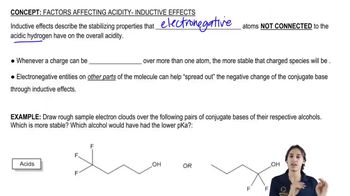
The inductive effect refers to the electron-withdrawing or electron-donating effects of substituents on a molecule. In alcohols, electron-withdrawing groups can stabilize the negative charge on the conjugate base, enhancing acidity. For example, alkyl groups are electron-donating, which can decrease acidity, while groups like halogens can increase it.
Recommended video:
Guided course
01:47
Understanding the Inductive Effect.

Hybridization and Acidity

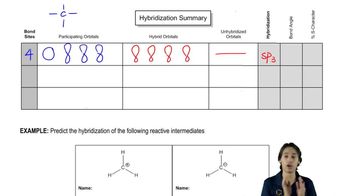
The hybridization of the carbon atom bonded to the hydroxyl group affects the acidity of alcohols. sp-hybridized carbons (like in HC≡CCH2OH) are more electronegative than sp2 or sp3 hybridized carbons, leading to a more stable conjugate base. Thus, alcohols with sp-hybridized carbons tend to be stronger acids compared to those with sp2 or sp3 hybridization.
Recommended video:
Guided course
10:43
Using bond sites to predict hybridization