Ch. 18 - Reactions of Benzene and Substituted Benzenes
Bruice - Organic Chemistry 8th Edition
Bruice8th EditionOrganic ChemistryISBN: 9780135213711Not the one you use?Change textbook
Chapter 19, Problem 96

Describe how 3-methyl-1-phenyl-3-pentanol can be prepared from benzene. You can use any inorganic reagents and solvents, and any organic reagents provided they contain no more than two carbons.

Verified step by step guidance
1
Step 1: Begin with benzene (C₆H₆) as the starting material. Perform a Friedel-Crafts acylation reaction using acetyl chloride (CH₃COCl) and aluminum chloride (AlCl₃) as the catalyst. This will introduce an acetyl group (-COCH₃) onto the benzene ring, forming acetophenone (C₆H₅COCH₃).
Step 2: Reduce the carbonyl group in acetophenone to a secondary alcohol. Use a reducing agent such as sodium borohydride (NaBH₄) in a suitable solvent like ethanol. This will convert acetophenone into 1-phenylethanol (C₆H₅CH(OH)CH₃).
Step 3: Prepare a Grignard reagent using bromoethane (C₂H₅Br) and magnesium (Mg) in anhydrous ether. This will form ethylmagnesium bromide (C₂H₅MgBr), which is a nucleophilic reagent.
Step 4: React the Grignard reagent (C₂H₅MgBr) with 1-phenylethanol. The Grignard reagent will attack the carbonyl carbon of the alcohol, forming a tertiary alcohol. This step will yield 3-methyl-1-phenyl-3-pentanol (C₆H₅CH(OH)CH₂CH(CH₃)CH₃) after hydrolysis with water or dilute acid.
Step 5: Purify the final product, 3-methyl-1-phenyl-3-pentanol, using standard organic purification techniques such as distillation or recrystallization, depending on the physical properties of the compound.

Verified video answer for a similar problem:

This video solution was recommended by our tutors as helpful for the problem above.
Was this helpful?

Key Concepts

Here are the essential concepts you must grasp in order to answer the question correctly.

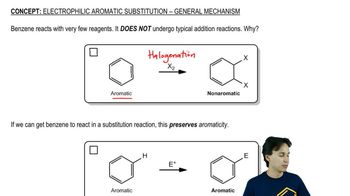
Electrophilic Aromatic Substitution

Electrophilic aromatic substitution (EAS) is a fundamental reaction in organic chemistry where an electrophile replaces a hydrogen atom on an aromatic ring. In the context of preparing 3-methyl-1-phenyl-3-pentanol from benzene, EAS allows for the introduction of functional groups onto the benzene ring, which is crucial for building the desired compound. Common electrophiles used in this process include alkyl halides and acyl chlorides.
Recommended video:

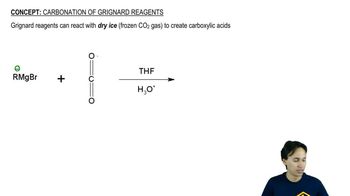
Grignard Reagents

Grignard reagents are organomagnesium compounds that act as nucleophiles in organic synthesis. They are formed by reacting magnesium with an alkyl or aryl halide and can react with carbonyl compounds to form alcohols. In the synthesis of 3-methyl-1-phenyl-3-pentanol, a Grignard reagent derived from a two-carbon halide can be used to add a carbon chain to a carbonyl compound, facilitating the formation of the target alcohol.
Recommended video:
Guided course
02:12
Carbonation of Grignard Reagents

Carbonyl Chemistry

Carbonyl chemistry involves the study of compounds containing a carbonyl group (C=O), which is a key functional group in organic molecules. In the preparation of 3-methyl-1-phenyl-3-pentanol, carbonyl compounds such as ketones or aldehydes can be utilized as intermediates. The reaction of a Grignard reagent with a carbonyl compound leads to the formation of an alcohol, which is essential for achieving the final product.
Recommended video:
Guided course
04:20
Carboxylic Acids Nomenclature