Ch. 18 - Reactions of Benzene and Substituted Benzenes
Bruice - Organic Chemistry 8th Edition
Bruice8th EditionOrganic ChemistryISBN: 9780135213711Not the one you use?Change textbook
Chapter 19, Problem 94

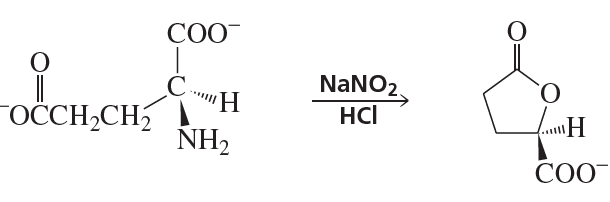
Propose a mechanism for the following reaction that explains why the configuration of the asymmetric center in the reactant is retained in the product:
Chemical reaction mechanism illustrating retention of configuration at an asymmetric center during an SN2 reaction.

Verified step by step guidance
1
Step 1: Recognize that the reaction involves the conversion of an amino acid to a cyclic compound. The key reagent, NaNO₂ in HCl, is used to generate nitrous acid (HNO₂), which reacts with the amino group to form a diazonium salt.
Step 2: The amino group (-NH₂) of the reactant undergoes diazotization. In acidic conditions, nitrous acid reacts with the amino group to form a diazonium ion (-N₂⁺). This step is crucial for the subsequent transformation.
Step 3: The diazonium ion undergoes intramolecular cyclization. The carboxylate group (-COO⁻) acts as a nucleophile and attacks the carbon adjacent to the diazonium group, leading to the formation of a cyclic intermediate.
Step 4: During the cyclization, the stereochemistry of the asymmetric center is retained because the reaction proceeds through a concerted mechanism that does not involve inversion of configuration. The nucleophilic attack occurs in a way that preserves the spatial arrangement of the substituents.
Step 5: The cyclic intermediate undergoes rearrangement and stabilization to form the final product, a cyclic compound with a retained stereochemistry at the asymmetric center. The product is stabilized by resonance and the formation of a keto group.

Verified video answer for a similar problem:

This video solution was recommended by our tutors as helpful for the problem above.
Video duration:
9m
Was this helpful?

Key Concepts

Here are the essential concepts you must grasp in order to answer the question correctly.

SN2 Reaction Mechanism

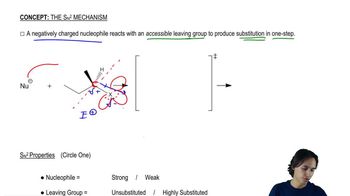
The SN2 (substitution nucleophilic bimolecular) mechanism involves a single concerted step where the nucleophile attacks the electrophile, leading to the displacement of a leaving group. This mechanism is characterized by a backside attack, which results in the inversion of configuration at the chiral center. In this case, the retention of configuration suggests that the reaction does not proceed via an SN2 pathway.
Recommended video:
Guided course
08:33
Drawing the SN2 Mechanism

Asymmetric Centers

An asymmetric center, or chiral center, is a carbon atom bonded to four different substituents, leading to non-superimposable mirror images known as enantiomers. The configuration of these centers is crucial in determining the stereochemistry of the product. Understanding how reactions affect these centers is essential for predicting the stereochemical outcome of organic reactions.
Recommended video:
Guided course
03:38
How to add to asymmetrical double bonds.

Diazotization Reaction

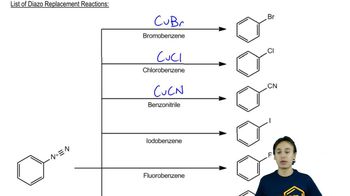
Diazotization is a reaction where an amine is converted into a diazonium salt using nitrous acid (NaNO2 in HCl). This process is significant in organic synthesis as it allows for the introduction of various functional groups through subsequent reactions. In the context of the question, the mechanism of diazotization helps explain how the configuration at the asymmetric center is retained in the product.
Recommended video:
Guided course
06:59
Replacement Reactions