Ch. 18 - Reactions of Benzene and Substituted Benzenes
Bruice - Organic Chemistry 8th Edition
Bruice8th EditionOrganic ChemistryISBN: 9780135213711Not the one you use?Change textbook
Chapter 19, Problem 92a

How can you distinguish the following compounds using: a. their infrared spectra?

Verified step by step guidance
1
First, identify the functional groups present in each compound. Compound (A) is a carboxylic acid, compound (B) is an aldehyde, and compound (C) is an ester.
Understand the characteristic IR absorption bands for each functional group. Carboxylic acids typically show a broad O-H stretch around 2500-3000 cm-1> and a C=O stretch near 1700 cm-1>. Aldehydes have a C=O stretch around 1720-1740 cm-1> and may show C-H stretches near 2700-2900 cm-1>. Esters exhibit a C=O stretch around 1735-1750 cm-1> and C-O stretches near 1050-1300 cm-1>.
Examine the IR spectrum for compound (A). Look for the broad O-H stretch and the C=O stretch, which are indicative of a carboxylic acid.
Analyze the IR spectrum for compound (B). Identify the C=O stretch and the C-H stretches that are characteristic of an aldehyde.
Review the IR spectrum for compound (C). Detect the C=O stretch and the C-O stretches, which are typical for an ester.

Verified video answer for a similar problem:

This video solution was recommended by our tutors as helpful for the problem above.
Video duration:
4m
Was this helpful?

Key Concepts

Here are the essential concepts you must grasp in order to answer the question correctly.

Infrared Spectroscopy

Infrared spectroscopy is an analytical technique used to identify functional groups in organic compounds by measuring the absorption of infrared light. Different bonds absorb characteristic wavelengths of infrared light, leading to distinct peaks in the spectrum. This allows chemists to determine the presence of specific functional groups, such as alcohols, aldehydes, and esters, based on their unique absorption patterns.
Recommended video:
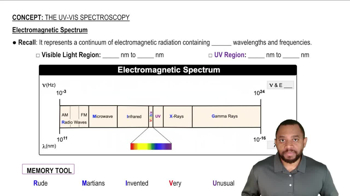
2:56
The UV-Vis Spectroscopy Concept 1

Functional Groups

Functional groups are specific groups of atoms within molecules that are responsible for the characteristic chemical reactions of those molecules. In the context of the compounds shown, the presence of hydroxyl (-OH), aldehyde (-CHO), and ester (-COOR) groups will influence the infrared spectrum. Recognizing these groups is essential for interpreting the spectra and distinguishing between the compounds.
Recommended video:
Guided course
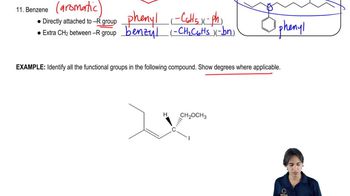
02:36
Identifying Functional Groups

Characteristic Absorption Peaks

Each functional group has a characteristic absorption peak in the infrared spectrum. For example, alcohols typically show a broad O-H stretch around 3200-3600 cm⁻¹, while carbonyl groups (C=O) appear around 1700 cm⁻¹. By analyzing these peaks, one can differentiate between compounds A, B, and C based on their unique functional groups and the corresponding absorption features in their infrared spectra.
Recommended video:
Guided course
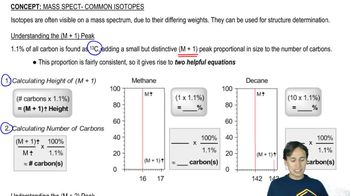
09:26
The (M + 1) Peak