Ch. 18 - Reactions of Benzene and Substituted Benzenes
Bruice - Organic Chemistry 8th Edition
Bruice8th EditionOrganic ChemistryISBN: 9780135213711Not the one you use?Change textbook
Chapter 19, Problem 99

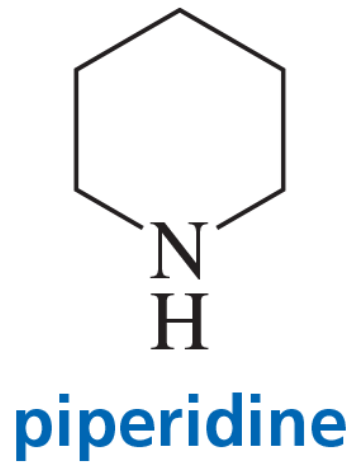
Explain why hydroxide ion catalyzes the reaction of piperidine with 2,4-dinitroanisole but has no effect on the reaction of piperidine with 1-chloro-2,4-dinitrobenzene.

Verified step by step guidance
1
Step 1: Understand the role of hydroxide ion in catalysis. Hydroxide ion (OH⁻) is a strong nucleophile and base, which can deprotonate certain compounds or participate in nucleophilic substitution reactions. Its catalytic effect depends on the chemical structure and reactivity of the substrate.
Step 2: Analyze the reaction of piperidine with 2,4-dinitroanisole. The methoxy group (-OCH₃) in 2,4-dinitroanisole is an electron-donating group, which makes the aromatic ring less electrophilic. However, the presence of two nitro groups (-NO₂) strongly activates the ring towards nucleophilic aromatic substitution (NAS). Hydroxide ion can enhance the reaction by deprotonating piperidine, increasing its nucleophilicity and facilitating the attack on the activated aromatic ring.
Step 3: Examine the reaction of piperidine with 1-chloro-2,4-dinitrobenzene. The chlorine atom (-Cl) is a good leaving group, and the two nitro groups (-NO₂) strongly activate the aromatic ring for nucleophilic aromatic substitution. Piperidine itself is sufficiently nucleophilic to react with 1-chloro-2,4-dinitrobenzene without requiring additional catalysis by hydroxide ion. Thus, hydroxide ion has no significant effect on this reaction.
Step 4: Compare the two reactions. In the case of 2,4-dinitroanisole, the methoxy group reduces the electrophilicity of the aromatic ring, making the reaction slower without hydroxide ion catalysis. In contrast, 1-chloro-2,4-dinitrobenzene has a highly activated ring due to the nitro groups and a good leaving group (chlorine), allowing the reaction to proceed efficiently without hydroxide ion.
Step 5: Conclude the explanation. Hydroxide ion catalyzes the reaction with 2,4-dinitroanisole by increasing the nucleophilicity of piperidine, overcoming the reduced electrophilicity caused by the methoxy group. However, it has no effect on the reaction with 1-chloro-2,4-dinitrobenzene because the substrate is already highly reactive due to the nitro groups and the presence of a good leaving group.

Verified video answer for a similar problem:

This video solution was recommended by our tutors as helpful for the problem above.
Video duration:
8m
Was this helpful?

Key Concepts

Here are the essential concepts you must grasp in order to answer the question correctly.

Nucleophilicity

Nucleophilicity refers to the ability of a nucleophile, such as the hydroxide ion (OH-), to donate an electron pair to an electrophile. In the context of the reactions mentioned, piperidine acts as a nucleophile, and its reactivity can be influenced by the nature of the electrophile. The presence of electron-withdrawing groups, like the nitro groups in 2,4-dinitroanisole, enhances the electrophilicity of the substrate, making it more susceptible to nucleophilic attack.
Recommended video:
Guided course
08:27
Nucleophilic Addition

Electrophilic Aromatic Substitution

Electrophilic aromatic substitution (EAS) is a fundamental reaction mechanism in organic chemistry where an electrophile replaces a hydrogen atom on an aromatic ring. In the case of 1-chloro-2,4-dinitrobenzene, the chlorine atom is a good leaving group, but the electron-withdrawing nitro groups stabilize the aromatic system, making it less reactive towards nucleophiles like hydroxide. This contrasts with 2,4-dinitroanisole, where the ether group can be protonated, facilitating nucleophilic attack.
Recommended video:

Base Catalysis

Base catalysis involves the acceleration of a reaction by a base, which can deprotonate a substrate or activate a nucleophile. In the reaction of piperidine with 2,4-dinitroanisole, hydroxide ion acts as a base, enhancing the nucleophilicity of piperidine. However, in the case of 1-chloro-2,4-dinitrobenzene, the reaction does not benefit from hydroxide catalysis due to the stability of the aromatic system and the nature of the leaving group, which does not require base assistance for the reaction to proceed.
Recommended video:
2:50
Acid-Base Catalysis Concept 3