Ch. 16 - Reactions of Aldehydes and Ketones • More Reactions of Carboxylic Acid Derivatives
Bruice - Organic Chemistry 8th Edition
Bruice8th EditionOrganic ChemistryISBN: 9780135213711Not the one you use?Change textbook
Chapter 17, Problem 74a

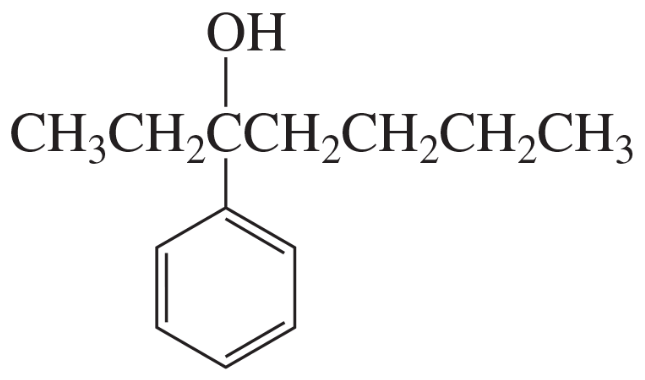
List three different sets of reagents (each set consisting of a carbonyl compound and a Grignard reagent) that could be used to prepare each of the following tertiary alcohols:
a.

Verified step by step guidance
1
Step 1: Analyze the structure of the tertiary alcohol provided. The alcohol group (-OH) is attached to a carbon atom that is bonded to three other groups: a phenyl group (benzene ring), an ethyl group (CH3CH2-), and a butyl group (CH3CH2CH2CH2-). This indicates that the alcohol is tertiary.
Step 2: Recall the general mechanism for forming tertiary alcohols using Grignard reagents. A Grignard reagent (R-MgX) reacts with a carbonyl compound (aldehyde or ketone) to form an alcohol. For tertiary alcohols, the carbonyl compound must be a ketone, and the Grignard reagent provides the third alkyl group.
Step 3: Identify possible combinations of ketones and Grignard reagents that could lead to the given tertiary alcohol. For example, one approach is to use acetophenone (C6H5COCH3) as the ketone and a Grignard reagent such as butyl magnesium bromide (CH3CH2CH2CH2MgBr). This reaction would add the butyl group to the carbonyl carbon, forming the desired alcohol.
Step 4: Consider alternative combinations. Another possibility is to use butanone (CH3CH2COCH3) as the ketone and phenyl magnesium bromide (C6H5MgBr) as the Grignard reagent. This reaction would add the phenyl group to the carbonyl carbon, forming the desired alcohol.
Step 5: Explore a third combination. You could use ethyl phenyl ketone (C6H5COCH2CH3) as the ketone and butyl magnesium bromide (CH3CH2CH2CH2MgBr) as the Grignard reagent. This reaction would add the butyl group to the carbonyl carbon, forming the desired alcohol.

Verified video answer for a similar problem:

This video solution was recommended by our tutors as helpful for the problem above.
Video duration:
5m
Was this helpful?

Key Concepts

Here are the essential concepts you must grasp in order to answer the question correctly.

Carbonyl Compounds

Carbonyl compounds are organic molecules characterized by the presence of a carbonyl group (C=O). They include aldehydes and ketones, which are crucial in organic synthesis. In the context of preparing tertiary alcohols, carbonyl compounds serve as electrophiles that react with nucleophiles, such as Grignard reagents, to form alcohols.
Recommended video:
Guided course
01:40
Defining meso compounds.

Grignard Reagents

Grignard reagents are organomagnesium compounds represented as RMgX, where R is an organic group and X is a halogen. They act as strong nucleophiles and are used to add carbon chains to carbonyl compounds. When a Grignard reagent reacts with a carbonyl compound, it forms an alkoxide intermediate, which can be protonated to yield an alcohol.
Recommended video:
Guided course
02:12
Carbonation of Grignard Reagents

Tertiary Alcohols

Tertiary alcohols are alcohols where the hydroxyl (-OH) group is attached to a carbon atom that is connected to three other carbon atoms. This structure makes them more sterically hindered and less reactive than primary or secondary alcohols. In synthesis, tertiary alcohols can be formed through the reaction of carbonyl compounds with Grignard reagents, which adds a carbon chain to the carbonyl carbon.
Recommended video:
2:07
Tertiary Protein Structure Concept 1