Ch. 16 - Reactions of Aldehydes and Ketones • More Reactions of Carboxylic Acid Derivatives
Bruice - Organic Chemistry 8th Edition
Bruice8th EditionOrganic ChemistryISBN: 9780135213711Not the one you use?Change textbook
Chapter 17, Problem 72c

How could you convert N-methylbenzamide to the following compounds?
c. methyl benzoate

Verified step by step guidance
1
Step 1: Recognize that N-methylbenzamide is an amide, and methyl benzoate is an ester. The conversion involves replacing the amide group (-CONHCH3) with an ester group (-COOCH3). This typically requires hydrolysis followed by esterification.
Step 2: Perform acidic or basic hydrolysis of N-methylbenzamide to break the amide bond. This will yield benzoic acid (C6H5COOH) and methylamine (CH3NH2). Use a strong acid like HCl or a strong base like NaOH for this step.
Step 3: Isolate the benzoic acid from the reaction mixture. If basic hydrolysis was used, acidify the solution to precipitate benzoic acid.
Step 4: React the benzoic acid with methanol (CH3OH) in the presence of an acid catalyst, such as sulfuric acid (H2SO4), to perform esterification. This will convert benzoic acid into methyl benzoate.
Step 5: Purify the methyl benzoate product using techniques such as distillation or recrystallization, depending on the reaction conditions and impurities.

Verified video answer for a similar problem:

This video solution was recommended by our tutors as helpful for the problem above.
Video duration:
5m
Was this helpful?

Key Concepts

Here are the essential concepts you must grasp in order to answer the question correctly.

Amide Hydrolysis

Amide hydrolysis is a reaction where an amide is converted into a carboxylic acid and an amine or ammonia, typically in the presence of water and an acid or base. This reaction is crucial for understanding how to transform N-methylbenzamide into its corresponding carboxylic acid, which can then be further converted into methyl benzoate.
Recommended video:
Guided course
01:33
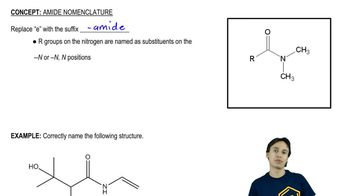
Amide Nomenclature

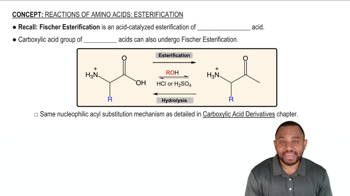
Esterification

Esterification is the process of forming an ester from a carboxylic acid and an alcohol, usually in the presence of an acid catalyst. In this case, the carboxylic acid derived from the hydrolysis of N-methylbenzamide can react with methanol to produce methyl benzoate, illustrating the importance of this reaction in organic synthesis.
Recommended video:
1:21
Reactions of Amino Acids: Esterification Concept 1

Nucleophilic Acyl Substitution

Nucleophilic acyl substitution is a fundamental reaction mechanism in organic chemistry where a nucleophile attacks the carbonyl carbon of an acyl compound, leading to the substitution of a leaving group. This mechanism is key in the conversion of the carboxylic acid formed from N-methylbenzamide into the ester methyl benzoate, as the alcohol acts as the nucleophile.
Recommended video:
Guided course
01:47
Nucleophiles and Electrophiles can react in Substitution Reactions.