Ch. 16 - Reactions of Aldehydes and Ketones • More Reactions of Carboxylic Acid Derivatives
Bruice - Organic Chemistry 8th Edition
Bruice8th EditionOrganic ChemistryISBN: 9780135213711Not the one you use?Change textbook
Chapter 17, Problem 72d

How could you convert N-methylbenzamide to the following compounds?
d. benzyl alcohol

Verified step by step guidance
1
Step 1: Begin by hydrolyzing N-methylbenzamide to benzoic acid. This can be achieved using acidic or basic hydrolysis conditions. For example, heating the compound with aqueous HCl or NaOH will break the amide bond, yielding benzoic acid and methylamine.
Step 2: Reduce the benzoic acid to benzyl alcohol. This can be done using a reducing agent such as lithium aluminum hydride (LiAlH4), which is highly effective for reducing carboxylic acids to primary alcohols.
Step 3: After the reduction, isolate and purify the benzyl alcohol product using techniques such as distillation or recrystallization, depending on the physical properties of the product.
Step 4: Confirm the structure of benzyl alcohol using spectroscopic methods such as NMR or IR. For example, the IR spectrum should show a broad O-H stretch around 3200-3600 cm⁻¹, and the NMR spectrum should display signals corresponding to the benzyl group and hydroxyl proton.
Step 5: Ensure that the reaction conditions are optimized to prevent over-reduction or side reactions, such as the formation of toluene from benzyl alcohol.

Verified video answer for a similar problem:

This video solution was recommended by our tutors as helpful for the problem above.
Video duration:
4m
Was this helpful?

Key Concepts

Here are the essential concepts you must grasp in order to answer the question correctly.

Amide Hydrolysis

Amide hydrolysis is a chemical reaction where an amide reacts with water to form a carboxylic acid and an amine or ammonia. In the case of N-methylbenzamide, hydrolysis can lead to the formation of benzoic acid and methylamine. This reaction is typically catalyzed by either acidic or basic conditions, which facilitate the breaking of the carbon-nitrogen bond.
Recommended video:
Guided course
01:33
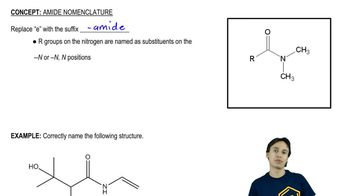
Amide Nomenclature

Reduction Reactions

Reduction reactions involve the gain of electrons or the decrease in oxidation state of a molecule. In organic chemistry, reducing agents such as lithium aluminum hydride (LiAlH4) or sodium borohydride (NaBH4) can convert carbonyl compounds into alcohols. In this context, the reduction of benzoic acid (formed from the hydrolysis of N-methylbenzamide) to benzyl alcohol is a key step in the transformation.
Recommended video:
Guided course
07:12
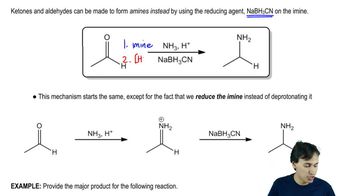
Reductive Amination

Functional Group Interconversion

Functional group interconversion refers to the transformation of one functional group into another within a molecule. In this case, converting the carboxylic acid (benzoic acid) into an alcohol (benzyl alcohol) is an example of functional group interconversion. This process is essential in organic synthesis, allowing chemists to modify compounds to achieve desired properties or reactivity.
Recommended video:
Guided course
02:36
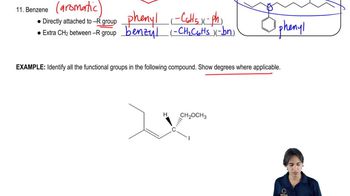
Identifying Functional Groups