Ch. 16 - Reactions of Aldehydes and Ketones • More Reactions of Carboxylic Acid Derivatives
Bruice - Organic Chemistry 8th Edition
Bruice8th EditionOrganic ChemistryISBN: 9780135213711Not the one you use?Change textbook
Chapter 17, Problem 74b

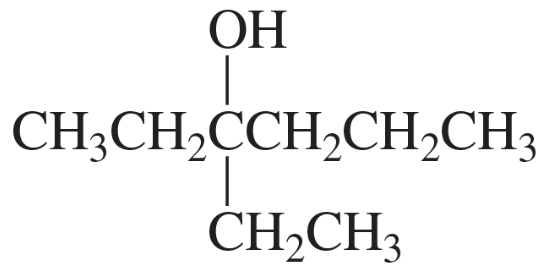
List three different sets of reagents (each set consisting of a carbonyl compound and a Grignard reagent) that could be used to prepare each of the following tertiary alcohols:
b.

Verified step by step guidance
1
Step 1: Analyze the structure of the tertiary alcohol provided. The central carbon is bonded to three alkyl groups (CH2CH3, CH2CH2CH3, and CH2CH3) and a hydroxyl group (-OH). This indicates that the alcohol is tertiary, meaning it was formed by the addition of a Grignard reagent to a carbonyl compound.
Step 2: To synthesize this tertiary alcohol, identify the carbonyl compound that would react with a Grignard reagent to form the desired structure. The carbonyl compound must have one of the alkyl groups already attached to the carbonyl carbon.
Step 3: Select the Grignard reagent that will add the remaining alkyl group to the carbonyl compound. Grignard reagents are organomagnesium compounds (R-MgX), where R is the alkyl group to be added.
Step 4: Repeat the process to identify three different sets of reagents. For example: (1) Use a ketone with one alkyl group and a Grignard reagent with another alkyl group, (2) Use a different ketone and Grignard reagent combination, and (3) Use an aldehyde and a Grignard reagent to achieve the same tertiary alcohol.
Step 5: Ensure that each set of reagents (carbonyl compound and Grignard reagent) leads to the formation of the same tertiary alcohol. Verify the connectivity of the alkyl groups and the hydroxyl group in the final product for each set.

Verified video answer for a similar problem:

This video solution was recommended by our tutors as helpful for the problem above.
Video duration:
4m
Was this helpful?

Key Concepts

Here are the essential concepts you must grasp in order to answer the question correctly.

Carbonyl Compounds

Carbonyl compounds are organic molecules that contain a carbon atom double-bonded to an oxygen atom (C=O). They are classified into two main types: aldehydes and ketones. Understanding the reactivity of carbonyl compounds is crucial, as they serve as electrophiles in nucleophilic addition reactions, which are fundamental in organic synthesis.
Recommended video:
Guided course
01:40
Defining meso compounds.

Grignard Reagents

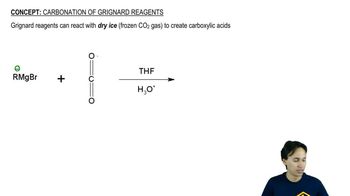
Grignard reagents are organomagnesium compounds represented as RMgX, where R is an organic group and X is a halogen. They are powerful nucleophiles that react with electrophiles, such as carbonyl compounds, to form new carbon-carbon bonds. Their ability to add to carbonyls is essential for synthesizing alcohols, particularly tertiary alcohols when reacting with ketones.
Recommended video:
Guided course
02:12
Carbonation of Grignard Reagents

Tertiary Alcohols

Tertiary alcohols are alcohols where the hydroxyl (-OH) group is attached to a carbon atom that is bonded to three other carbon atoms. They are typically formed through the reaction of Grignard reagents with ketones. Understanding the structure and formation of tertiary alcohols is important for predicting the outcomes of organic reactions and for designing synthetic pathways.
Recommended video:
2:07
Tertiary Protein Structure Concept 1