
Using the mechanism for the acid-catalyzed hydrolysis of an ester as your guide, write the mechanism—showing all the curved arrows—for the acid-catalyzed reaction of acetic acid and methanol to form methyl acetate. Use HB+ and :B to represent the proton-donating and proton-removing species, respectively.
Ch. 15 - Reactions of Carboxylic Acids and Carboxylic Acid Derivatives
All textbooks
Bruice 8th Edition
Ch. 15 - Reactions of Carboxylic Acids and Carboxylic Acid Derivatives
Problem 24
Bruice 8th Edition
Ch. 15 - Reactions of Carboxylic Acids and Carboxylic Acid Derivatives
Problem 24Chapter 16, Problem 24
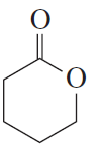
Show the mechanism for the acid-catalyzed formation of 23c starting with the product obtained from its hydrolysis.

Verified step by step guidance1
Identify the product obtained from the hydrolysis reaction. Hydrolysis typically involves breaking a bond in the presence of water, often yielding a carboxylic acid, alcohol, or other functional groups depending on the starting material.
Determine the structure of 23c and analyze its functional groups. This will help you understand the transformation required to form 23c from the hydrolysis product.
Propose the acid-catalyzed mechanism. Acid catalysis often involves protonation of a functional group to make it more electrophilic or reactive. For example, if the hydrolysis product contains a carbonyl group, protonation of the carbonyl oxygen will increase the electrophilicity of the carbonyl carbon.
Outline the nucleophilic attack or rearrangement step. After protonation, a nucleophile (such as an alcohol or water) may attack the electrophilic center, or a rearrangement may occur to form the desired product, 23c.
Conclude the mechanism by showing the deprotonation step to regenerate the acid catalyst and stabilize the final product, 23c. Ensure all intermediates and electron-pushing arrows are accounted for in the mechanism.

Verified video answer for a similar problem:
This video solution was recommended by our tutors as helpful for the problem above.
Video duration:
6mWas this helpful?
Key Concepts
Here are the essential concepts you must grasp in order to answer the question correctly.
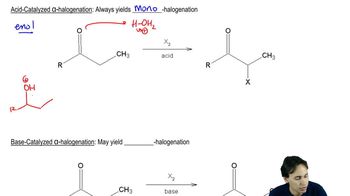
Acid-Catalyzed Reactions
Acid-catalyzed reactions involve the use of an acid to increase the rate of a chemical reaction. In organic chemistry, acids can donate protons (H+) to facilitate the formation of reactive intermediates, such as carbocations. This mechanism often leads to the rearrangement or transformation of molecules, making it essential for understanding how certain products are formed from their precursors.
Recommended video:
Guided course
Acid Catalyzed
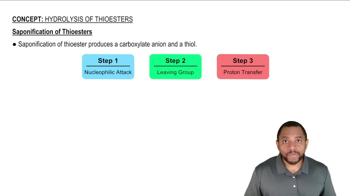
Hydrolysis
Hydrolysis is a chemical reaction in which water is used to break down a compound. In organic chemistry, hydrolysis often involves the cleavage of bonds in larger molecules, resulting in smaller products. Understanding hydrolysis is crucial for tracing the origin of the starting material in the acid-catalyzed formation of a product, as it provides insight into the functional groups and structural changes involved.
Recommended video:
Hydrolysis of Thioesters Concept 2
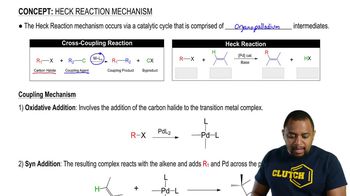
Reaction Mechanism
A reaction mechanism is a step-by-step description of the process by which reactants are converted into products. It outlines the sequence of elementary steps, including the formation and transformation of intermediates. Analyzing the mechanism is vital for predicting the outcome of a reaction, understanding the role of catalysts, and identifying the conditions necessary for the reaction to proceed.
Recommended video:
Guided course
Heck Reaction Mechanism
Related Practice
Textbook Question
2
views
Textbook Question
Write the mechanism for the acid-catalyzed transesterification of ethyl acetate with methanol.
1
views
Textbook Question
Write the mechanism for the acid-catalyzed reaction of tert-butyl acetate with methanol.
7
views
Textbook Question
In the mechanism for the acid-catalyzed hydrolysis of an ester,
c. what species is HB+ most likely to be in the hydrolysis reaction?
d. what species is HB+ most likely to be in the reverse reaction?
1
views
Textbook Question
What products are formed from the acid-catalyzed hydrolysis of the following esters?
a.
b.
1
views
Textbook Question
What products are obtained from the following reactions? b. phenyl acetate + excess ethanol + HCl
7
views