Ch. 15 - Reactions of Carboxylic Acids and Carboxylic Acid Derivatives
Bruice - Organic Chemistry 8th Edition
Bruice8th EditionOrganic ChemistryISBN: 9780135213711Not the one you use?Change textbook
Chapter 16, Problem 22a

Using the mechanism for the acid-catalyzed hydrolysis of an ester as your guide, write the mechanism—showing all the curved arrows—for the acid-catalyzed reaction of acetic acid and methanol to form methyl acetate. Use HB+ and :B to represent the proton-donating and proton-removing species, respectively.

Verified step by step guidance
1
Protonation of the carbonyl oxygen: The reaction begins with the protonation of the carbonyl oxygen in acetic acid by the acid catalyst (HB+). This increases the electrophilicity of the carbonyl carbon, making it more susceptible to nucleophilic attack. Represent this step with a curved arrow from the lone pair on the carbonyl oxygen to the proton (H) of HB+.
Nucleophilic attack by methanol: Methanol acts as a nucleophile and attacks the carbonyl carbon of the protonated acetic acid. Draw a curved arrow from the lone pair on the oxygen of methanol to the carbonyl carbon. This forms a tetrahedral intermediate with a positively charged oxygen on the methanol group.
Proton transfer: A proton transfer occurs to stabilize the intermediate. The positively charged oxygen on the methanol group donates a proton to a base (:B), forming a neutral intermediate. Represent this step with a curved arrow from the oxygen-hydrogen bond to the base (:B).
Formation of the ester: The intermediate undergoes elimination of water. The lone pair on the oxygen of the hydroxyl group reforms the carbonyl bond, and a curved arrow is drawn to show the departure of water as a leaving group. This step forms methyl acetate.
Regeneration of the catalyst: The acid catalyst (HB+) is regenerated by the protonation of the base (:B) with a proton. Draw a curved arrow from the lone pair on the base (:B) to the proton (H) to complete the catalytic cycle.

Verified video answer for a similar problem:

This video solution was recommended by our tutors as helpful for the problem above.
Video duration:
3m
Was this helpful?

Key Concepts

Here are the essential concepts you must grasp in order to answer the question correctly.

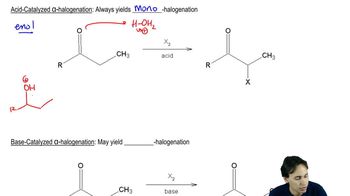
Acid-Catalyzed Hydrolysis

Acid-catalyzed hydrolysis involves the reaction of an ester with water in the presence of an acid, leading to the formation of an alcohol and a carboxylic acid. The acid donates a proton to the ester, enhancing its electrophilicity, which facilitates the nucleophilic attack by water. This mechanism typically includes protonation steps and the formation of a tetrahedral intermediate.
Recommended video:
Guided course
03:09
Acid Catalyzed

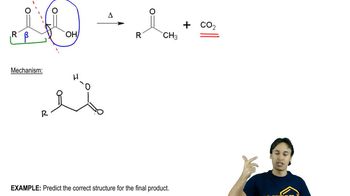
Curved Arrows in Mechanisms

Curved arrows are used in organic chemistry to illustrate the movement of electrons during chemical reactions. A curved arrow starts from a nucleophile (electron donor) and points to an electrophile (electron acceptor), indicating the formation of a bond. Understanding how to correctly use these arrows is crucial for depicting reaction mechanisms accurately.
Recommended video:
Guided course
04:32
General Mechanism

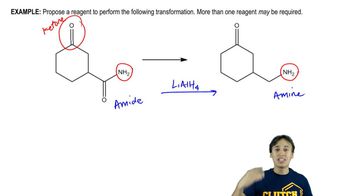
Formation of Methyl Acetate

The reaction between acetic acid and methanol to form methyl acetate is an example of an esterification reaction, where an alcohol reacts with a carboxylic acid. In this process, the hydroxyl group of acetic acid is replaced by a methoxy group from methanol, resulting in the formation of the ester methyl acetate and water. This reaction is reversible and can be driven to completion by removing water.
Recommended video:
Guided course
04:29
Acetal Protecting Group