Ch. 15 - Reactions of Carboxylic Acids and Carboxylic Acid Derivatives
Bruice - Organic Chemistry 8th Edition
Bruice8th EditionOrganic ChemistryISBN: 9780135213711Not the one you use?Change textbook
Chapter 16, Problem 21c,d

In the mechanism for the acid-catalyzed hydrolysis of an ester,
c. what species is HB+ most likely to be in the hydrolysis reaction?
d. what species is HB+ most likely to be in the reverse reaction?

Verified step by step guidance
1
Step 1: Understand the context of the problem. The acid-catalyzed hydrolysis of an ester involves breaking the ester bond in the presence of an acid catalyst, typically resulting in the formation of a carboxylic acid and an alcohol. The acid catalyst donates a proton (H⁺) to facilitate the reaction.
Step 2: Identify the role of HB⁺ in the hydrolysis reaction. HB⁺ represents the conjugate acid of the base (B) present in the reaction. In the hydrolysis reaction, HB⁺ is most likely the protonated form of the solvent or a species that can donate a proton to stabilize intermediates.
Step 3: Analyze the forward reaction (hydrolysis). In the forward reaction, water (H₂O) is typically the nucleophile that attacks the carbonyl carbon of the ester. The acid catalyst (H⁺) protonates the carbonyl oxygen to make the carbonyl carbon more electrophilic. HB⁺ is most likely H₃O⁺ (hydronium ion), which is the protonated form of water.
Step 4: Analyze the reverse reaction (esterification). In the reverse reaction, the carboxylic acid and alcohol combine to reform the ester. The acid catalyst (H⁺) protonates the hydroxyl group of the carboxylic acid to make it a better leaving group. HB⁺ in this case is also most likely H₃O⁺, as the reaction occurs in an acidic environment.
Step 5: Conclude that in both the forward (hydrolysis) and reverse (esterification) reactions, HB⁺ is most likely H₃O⁺, as it is the conjugate acid of water and plays a key role in the acid-catalyzed mechanism.

Verified video answer for a similar problem:

This video solution was recommended by our tutors as helpful for the problem above.
Video duration:
1m
Was this helpful?

Key Concepts

Here are the essential concepts you must grasp in order to answer the question correctly.

Acid-Catalyzed Hydrolysis

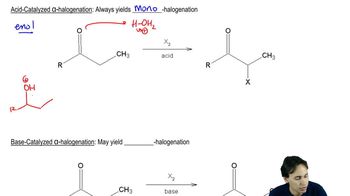
Acid-catalyzed hydrolysis is a reaction where an ester reacts with water in the presence of an acid catalyst, typically a proton donor like HCl or H2SO4. The acid increases the electrophilicity of the carbonyl carbon in the ester, facilitating the nucleophilic attack by water. This process results in the formation of an alcohol and a carboxylic acid.
Recommended video:
Guided course
03:09
Acid Catalyzed

Protonation and HB+ Species

In organic reactions, HB+ represents a protonated species, often a conjugate acid formed when a base accepts a proton. In the context of acid-catalyzed hydrolysis, HB+ is likely to be the protonated form of the alcohol or water, which stabilizes the transition state and promotes the reaction. Understanding the role of HB+ is crucial for predicting the direction and products of the reaction.
Recommended video:
Guided course
03:
Proton Splitting

Reversibility of Reactions

Many organic reactions, including hydrolysis, are reversible. In the reverse reaction, the products (alcohol and carboxylic acid) can recombine to form the original ester, especially under certain conditions. The species HB+ in the reverse reaction is typically the protonated form of the carboxylic acid, which can facilitate the reformation of the ester by donating a proton to the alcohol.
Recommended video:
Guided course
11:50
EAS Reactions Overview