Ch. 15 - Reactions of Carboxylic Acids and Carboxylic Acid Derivatives
Bruice - Organic Chemistry 8th Edition
Bruice8th EditionOrganic ChemistryISBN: 9780135213711Not the one you use?Change textbook
Chapter 16, Problem 27

Write the mechanism for the acid-catalyzed reaction of tert-butyl acetate with methanol.

Verified step by step guidance
1
Protonation of the carbonyl oxygen: The reaction begins with the protonation of the carbonyl oxygen in tert-butyl acetate by the acid catalyst (H⁺). This increases the electrophilicity of the carbonyl carbon, making it more susceptible to nucleophilic attack. The structure of the protonated intermediate can be represented as: CH3C3(COH).
Nucleophilic attack by methanol: Methanol (CH₃OH) acts as a nucleophile and attacks the electrophilic carbonyl carbon of the protonated ester. This forms a tetrahedral intermediate where the carbonyl oxygen now bears a positive charge.
Proton transfer: A proton transfer occurs within the tetrahedral intermediate to stabilize the structure. The hydroxyl group (OH) formed from the methanol attack is deprotonated, while the leaving group (tert-butoxide) is protonated to prepare for its departure.
Elimination of the leaving group: The protonated tert-butoxide group (tert-butyl alcohol) leaves, resulting in the formation of a new ester bond between the carbonyl carbon and the methanol oxygen. This step regenerates the acid catalyst (H⁺).
Final product formation: The final product of the reaction is methyl acetate (CH₃COOCH₃) and tert-butyl alcohol (C₄H₁₀O). The acid catalyst is regenerated, allowing the reaction to proceed catalytically.

Verified video answer for a similar problem:

This video solution was recommended by our tutors as helpful for the problem above.
Was this helpful?

Key Concepts

Here are the essential concepts you must grasp in order to answer the question correctly.

Acid-Catalyzed Reactions

Acid-catalyzed reactions involve the use of an acid to increase the rate of a chemical reaction. In these reactions, the acid donates a proton (H+) to a reactant, enhancing its electrophilicity and facilitating nucleophilic attack. This mechanism is crucial in esterification and hydrolysis reactions, where the presence of an acid can significantly alter the reaction pathway and products.
Recommended video:
Guided course
03:09
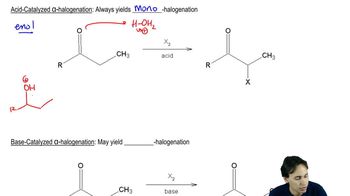
Acid Catalyzed

Nucleophilic Substitution Mechanism

Nucleophilic substitution is a fundamental reaction mechanism in organic chemistry where a nucleophile attacks an electrophile, resulting in the replacement of a leaving group. In the case of tert-butyl acetate reacting with methanol, methanol acts as the nucleophile, attacking the carbonyl carbon of the acetate. Understanding this mechanism is essential for predicting the outcome of the reaction and the stability of intermediates formed during the process.
Recommended video:
Guided course
01:47
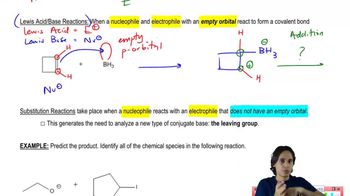
Nucleophiles and Electrophiles can react in Substitution Reactions.

Ester Hydrolysis

Ester hydrolysis is the process by which an ester reacts with water (or an alcohol) to form an alcohol and a carboxylic acid. In acid-catalyzed hydrolysis, the ester is protonated, making it more susceptible to nucleophilic attack by water or alcohol. This reaction is important in organic synthesis and biochemistry, as it illustrates the reversible nature of ester formation and breakdown, which is key in many biological processes.
Recommended video:
0:48
Hydrolysis of Phosphate Esters Concept 2