Ch. 15 - Reactions of Carboxylic Acids and Carboxylic Acid Derivatives
Bruice - Organic Chemistry 8th Edition
Bruice8th EditionOrganic ChemistryISBN: 9780135213711Not the one you use?Change textbook
Chapter 16, Problem 28b(ii)

b. Explain why the rate of aminolysis of an ester cannot be increased by HO, or RO.

Verified step by step guidance
1
The aminolysis of an ester involves the reaction of an ester with an amine to form an amide and an alcohol. This reaction proceeds via a nucleophilic acyl substitution mechanism.
In the mechanism, the amine acts as the nucleophile, attacking the carbonyl carbon of the ester. The carbonyl carbon is electrophilic due to the partial positive charge caused by the electronegativity of the oxygen atom in the carbonyl group.
Adding HO⁻ (hydroxide ion) or RO⁻ (alkoxide ion) does not increase the rate of aminolysis because these species are stronger nucleophiles than the amine. If present, they would compete with the amine for the carbonyl carbon, leading to hydrolysis or transesterification instead of aminolysis.
Additionally, the reaction environment for aminolysis is typically neutral or slightly basic to avoid deprotonating the amine. If the solution becomes too basic due to the presence of HO⁻ or RO⁻, the amine may be deprotonated to form an amide ion (RNH⁻), which is a much weaker nucleophile and would slow down the reaction.
Thus, the rate of aminolysis cannot be increased by HO⁻ or RO⁻ because these bases either compete with the amine or alter the reaction conditions in a way that hinders the nucleophilic attack by the amine.

Verified video answer for a similar problem:

This video solution was recommended by our tutors as helpful for the problem above.
Video duration:
2m
Was this helpful?

Key Concepts

Here are the essential concepts you must grasp in order to answer the question correctly.

Aminolysis of Esters

Aminolysis is a nucleophilic substitution reaction where an amine reacts with an ester to form an amide and an alcohol. In this process, the nucleophile (amine) attacks the carbonyl carbon of the ester, leading to the displacement of the leaving group. Understanding the mechanism of this reaction is crucial to analyze how different nucleophiles affect the reaction rate.
Recommended video:
Guided course
02:39
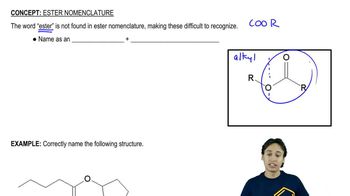
Ester Nomenclature

Nucleophilicity

Nucleophilicity refers to the strength of a nucleophile in donating an electron pair to form a new bond. In the context of aminolysis, the nucleophile's ability to attack the electrophilic carbonyl carbon of the ester is essential. Hydroxide (HO−) and alkoxide (RO−) ions are strong nucleophiles, but their basicity can lead to competing reactions, which can affect the overall reaction rate.
Recommended video:
Guided course
08:27
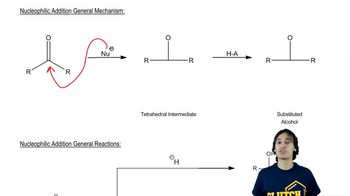
Nucleophilic Addition

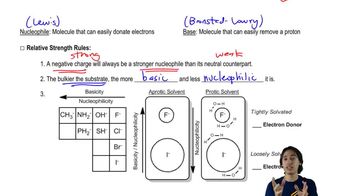
Basicity vs. Nucleophilicity

Basicity is the tendency of a species to accept protons, while nucleophilicity is its ability to donate electron pairs. In the case of HO− and RO−, their strong basicity can lead to deprotonation of the amine, reducing the effective concentration of the nucleophile needed for aminolysis. This competition between basicity and nucleophilicity explains why increasing the concentration of these bases does not enhance the rate of aminolysis.
Recommended video:
Guided course
06:21
Understanding the difference between basicity and nucleophilicity.