Ch. 14 - NMR Spectroscopy
Bruice - Organic Chemistry 8th Edition
Bruice8th EditionOrganic ChemistryISBN: 9780135213711Not the one you use?Change textbook
Chapter 15, Problem 13a,b

Which underlined proton (or sets of protons) has the greater chemical shift (that is, the higher frequency signal)?
a.
b.

Verified step by step guidance
1
Step 1: Understand the concept of chemical shift in NMR spectroscopy. Chemical shift is influenced by the electronic environment around a proton. Electronegative atoms or groups deshield the proton, causing a higher chemical shift (downfield signal).
Step 2: Analyze the first pair of protons in part (i). The proton attached to the carbon bonded to chlorine (Cl) is more deshielded compared to the proton attached to the carbon bonded to iodine (I). Chlorine is more electronegative than iodine, pulling electron density away from the proton more effectively.
Step 3: Compare the second pair of protons in part (ii). The proton attached to the carbon bonded to bromine (Br) is less deshielded compared to the proton in the aldehyde group. The aldehyde proton is highly deshielded due to the electron-withdrawing effect of the carbonyl group (C=O).
Step 4: Summarize the findings. In part (i), the proton near chlorine has the greater chemical shift. In part (ii), the aldehyde proton has the greater chemical shift due to the strong deshielding effect of the carbonyl group.
Step 5: Conclude that the chemical shift is determined by the electronegativity and electron-withdrawing effects of nearby atoms or functional groups. This principle can be applied to predict chemical shifts in other molecules.

Verified video answer for a similar problem:

This video solution was recommended by our tutors as helpful for the problem above.
Video duration:
3m
Was this helpful?

Key Concepts

Here are the essential concepts you must grasp in order to answer the question correctly.

Chemical Shift in NMR Spectroscopy

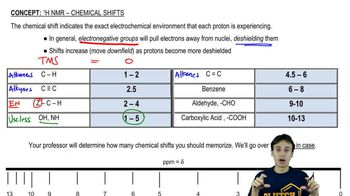
Chemical shift refers to the resonance frequency of a nucleus relative to a standard in a magnetic field, typically measured in parts per million (ppm). In proton NMR, the chemical shift is influenced by the electronic environment surrounding the hydrogen atoms. Protons near electronegative atoms or in deshielded environments resonate at higher frequencies, resulting in greater chemical shifts.
Recommended video:
Guided course
11:44
1H NMR Chemical Shifts

Electronegativity and Shielding Effects

Electronegativity is the tendency of an atom to attract electrons towards itself. In NMR, protons attached to carbon atoms adjacent to electronegative atoms (like Cl, Br, or O) experience deshielding, which increases their chemical shift. This means that protons in such environments will resonate at higher frequencies compared to those in more shielded environments, such as those attached to carbon atoms in saturated hydrocarbons.
Recommended video:
Guided course
1:47
Electronegativity

Integration and Multiplicity in NMR

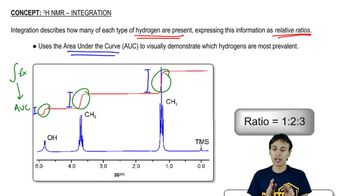
Integration in NMR spectroscopy refers to the area under the peaks in the spectrum, which correlates to the number of protons contributing to that signal. Multiplicity indicates the splitting of NMR signals due to neighboring protons, following the n+1 rule, where n is the number of adjacent protons. Understanding these concepts helps in interpreting the NMR spectrum and identifying the environment of specific protons.
Recommended video:
Guided course
06:46
1H NMR Integration