If two signals differ by 1.5 ppm in a 300 MHz spectrometer, by how much do they differ in a 500 MHz spectrometer?
Ch. 14 - NMR Spectroscopy
Chapter 15, Problem 12c,d
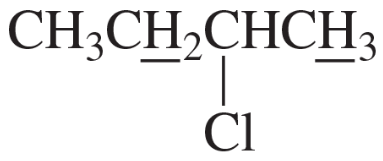
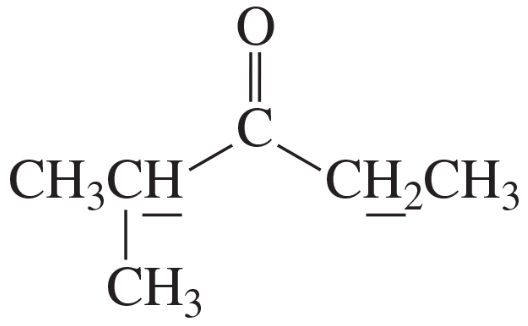
Which underlined proton (or sets of protons) has the greater chemical shift (that is, the higher frequency signal)?
c. 
d. 
Verified step by step guidance1
Step 1: Understand the concept of chemical shift in NMR spectroscopy. Chemical shift is influenced by the electronic environment around a proton. Electronegative atoms, pi bonds, and other factors can deshield protons, causing them to resonate at higher frequencies (downfield).
Step 2: Analyze the structure in image i. The red proton is adjacent to a chlorine atom, which is highly electronegative. This electronegativity deshields the red proton, increasing its chemical shift. The blue protons are further away from the chlorine atom and are less affected by its electronegativity, resulting in a lower chemical shift.
Step 3: Analyze the structure in image ii. The red proton is adjacent to a bromine atom, which is less electronegative than chlorine but still deshields the proton to some extent. Additionally, the red proton is closer to the carbonyl group (C=O), which is highly deshielding due to its electron-withdrawing nature. The blue protons are adjacent to a hydroxyl group (-OH), which also has an electron-withdrawing effect but is less deshielding compared to the carbonyl group.
Step 4: Compare the chemical shifts of the red and blue protons in both structures. In image i, the red proton has a higher chemical shift due to the strong deshielding effect of the chlorine atom. In image ii, the red proton has a higher chemical shift due to the combined deshielding effects of the bromine atom and the carbonyl group.
Step 5: Conclude that in both cases (c and d), the red proton has the greater chemical shift compared to the blue protons due to its proximity to electronegative atoms and electron-withdrawing groups.

Verified video answer for a similar problem:
This video solution was recommended by our tutors as helpful for the problem above.
Video duration:
4mWas this helpful?
Key Concepts
Here are the essential concepts you must grasp in order to answer the question correctly.
Chemical Shift in NMR Spectroscopy
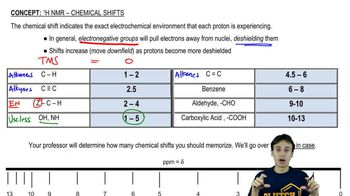
Chemical shift refers to the resonance frequency of a nucleus relative to a standard in a magnetic field, typically measured in parts per million (ppm). In proton NMR, the chemical shift is influenced by the electronic environment surrounding the protons, with electronegative atoms or groups causing downfield shifts (higher ppm) due to deshielding effects.
Recommended video:
Guided course
1H NMR Chemical Shifts
Deshielding and Shielding Effects
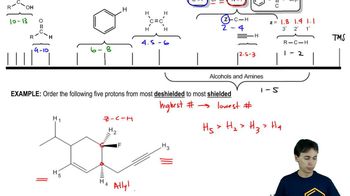
Shielding occurs when surrounding electrons reduce the magnetic field experienced by a nucleus, resulting in a lower chemical shift. Conversely, deshielding happens when electronegative atoms withdraw electron density from protons, increasing their chemical shift. Protons near electronegative atoms, such as halogens or oxygen, will typically resonate at higher frequencies.
Recommended video:
Guided course
Ranking Shielded Protons
Comparative Analysis of Proton Environments
In NMR analysis, comparing the environments of protons in different molecular structures is crucial for determining their chemical shifts. Protons in similar environments will have similar shifts, while those influenced by different electronegative groups or steric effects will show significant differences. This comparative analysis helps identify which protons resonate at higher frequencies.
Recommended video:
Guided course
Comparing hydrocarbon acidity
Related Practice
Textbook Question
1
views
Textbook Question
Which underlined proton (or sets of protons) has the greater chemical shift (that is, the higher frequency signal)?
a.
b.
4
views
Textbook Question
Without referring to Table 14.1, label the proton or set of protons in each compound that gives the signal at the lowest frequency a, at the next lowest b, and so on.
e.
3
views
Textbook Question
Draw an isomer of dichlorocyclopropane that gives an 1H NMR spectrum
c. with three signals
1
views
Textbook Question
Without referring to Table 14.1, label the proton or set of protons in each compound that gives the signal at the lowest frequency a, at the next lowest b, and so on.
c. ClCH2CH2CH2Cl
1
views
Textbook Question
If two signals differ by 90 Hz in a 300 MHz spectrometer, by how much do they differ in a 500 MHz spectrometer