Ch. 14 - NMR Spectroscopy
Bruice - Organic Chemistry 8th Edition
Bruice8th EditionOrganic ChemistryISBN: 9780135213711Not the one you use?Change textbook
Chapter 15, Problem 9b

If two signals differ by 90 Hz in a 300 MHz spectrometer, by how much do they differ in a 500 MHz spectrometer

Verified step by step guidance
1
Understand the relationship between the frequency difference (in Hz) and the spectrometer's operating frequency (in MHz). The chemical shift difference (Δδ) in ppm is independent of the spectrometer frequency and is calculated as Δδ = Δν / ν₀, where Δν is the frequency difference in Hz and ν₀ is the spectrometer frequency in MHz.
Calculate the chemical shift difference (Δδ) in ppm for the 300 MHz spectrometer using the given frequency difference of 90 Hz. Use the formula Δδ = Δν / ν₀, where Δν = 90 Hz and ν₀ = 300 MHz.
Recognize that the chemical shift difference (Δδ) remains constant regardless of the spectrometer frequency. This means the same Δδ value applies to the 500 MHz spectrometer.
Determine the new frequency difference (Δν) in Hz for the 500 MHz spectrometer using the formula Δν = Δδ × ν₀, where Δδ is the value calculated in step 2 and ν₀ = 500 MHz.
Conclude that the frequency difference in Hz for the 500 MHz spectrometer is proportional to the spectrometer frequency and will be larger than the 90 Hz difference observed in the 300 MHz spectrometer.

Verified video answer for a similar problem:

This video solution was recommended by our tutors as helpful for the problem above.
Was this helpful?

Key Concepts

Here are the essential concepts you must grasp in order to answer the question correctly.

Frequency and Spectroscopy

In spectroscopy, frequency refers to the number of oscillations of a signal per second, measured in Hertz (Hz). Different spectrometers operate at different base frequencies, which affects how signals are detected and interpreted. Understanding the relationship between frequency and the spectrometer's operating frequency is crucial for analyzing spectral data.
Recommended video:
Guided course
16:47
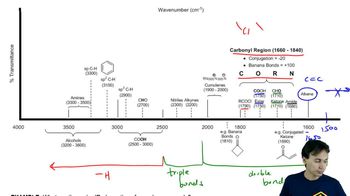
Common IR Frequencies

Relative Frequency Difference

The relative frequency difference between two signals is the difference in their frequencies, expressed as a ratio to the base frequency of the spectrometer. This concept is important for determining how the perceived difference in frequency changes when switching between spectrometers with different operating frequencies, as it helps maintain consistency in analysis.
Recommended video:
Guided course
16:47
Common IR Frequencies

Proportionality in Spectrometers

The difference in frequency between two signals is proportional to the operating frequency of the spectrometer. This means that if the base frequency increases, the absolute difference in frequency will also increase proportionally. Understanding this proportionality allows for accurate calculations when comparing signals across different spectrometer frequencies.
Recommended video:
Guided course
05:29
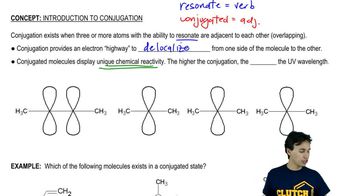
Definition of Conjugation