
Ch. 14 - NMR Spectroscopy
Bruice - Organic Chemistry 8th Edition
Bruice8th EditionOrganic ChemistryISBN: 9780135213711Not the one you use?Change textbook
Chapter 15, Problem 14e

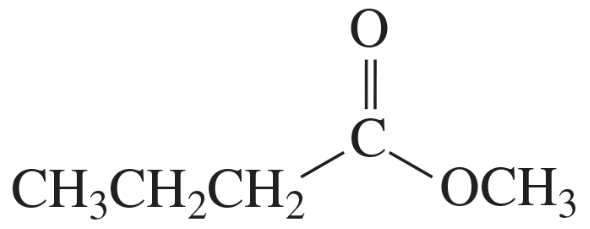
Without referring to Table 14.1, label the proton or set of protons in each compound that gives the signal at the lowest frequency a, at the next lowest b, and so on.
e.

Verified step by step guidance
1
Step 1: Analyze the structure of the compound provided. The molecule contains a ketone functional group (C=O) and several types of protons attached to different carbon environments.
Step 2: Identify the different sets of protons in the molecule. These include: (a) the methyl protons (CH3) attached to the tertiary carbon, (b) the methylene protons (CH2) adjacent to the carbonyl group, and (c) the aldehyde proton (H attached to the carbonyl carbon).
Step 3: Consider the chemical environment of each set of protons. The aldehyde proton is deshielded due to the electronegative oxygen in the carbonyl group, making it resonate at the highest frequency. The methylene protons are less deshielded but still influenced by the carbonyl group, resonating at a lower frequency than the aldehyde proton. The methyl protons are in a relatively shielded environment, resonating at the lowest frequency.
Step 4: Assign labels based on the frequency of resonance. The methyl protons (CH3) resonate at the lowest frequency and are labeled 'a'. The methylene protons (CH2) resonate at the next lowest frequency and are labeled 'b'. The aldehyde proton resonates at the highest frequency and is labeled 'c'.
Step 5: Summarize the labeling: (a) methyl protons (CH3), (b) methylene protons (CH2), (c) aldehyde proton (H attached to the carbonyl carbon). This order reflects the increasing frequency of resonance due to the chemical environment.

Verified video answer for a similar problem:

This video solution was recommended by our tutors as helpful for the problem above.
Video duration:
4m
Was this helpful?

Key Concepts

Here are the essential concepts you must grasp in order to answer the question correctly.

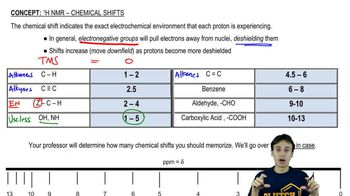
Chemical Shift in NMR Spectroscopy

The chemical shift in NMR spectroscopy refers to the resonance frequency of a nucleus relative to a standard in a magnetic field. It is influenced by the electronic environment surrounding the nucleus, with protons in electron-rich environments appearing at higher frequencies (lower ppm values) and those in electron-poor environments at lower frequencies (higher ppm values). Understanding chemical shifts is crucial for interpreting NMR spectra and identifying different types of protons in a molecule.
Recommended video:
Guided course
11:44
1H NMR Chemical Shifts

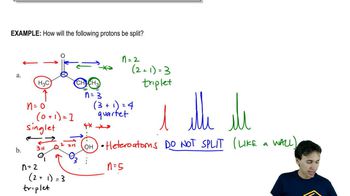
Proton Environment

The proton environment describes the specific surroundings of hydrogen atoms in a molecule, which can affect their NMR signals. Factors such as electronegativity of nearby atoms, hybridization, and steric hindrance can alter the magnetic environment, leading to variations in chemical shifts. Recognizing the different environments helps in predicting which protons will resonate at lower or higher frequencies in an NMR spectrum.
Recommended video:
Guided course
03:
Proton Splitting

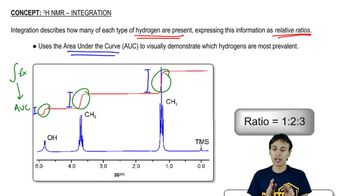
Integration in NMR

Integration in NMR spectroscopy refers to the area under the peaks in the spectrum, which correlates to the number of protons contributing to that signal. This quantitative aspect allows chemists to determine the relative number of protons in different environments. By analyzing the integration values, one can deduce the structure of the compound and the ratio of different types of protons present.
Recommended video:
Guided course
06:46
1H NMR Integration