Ch. 11 - Organometallic Compounds
Bruice - Organic Chemistry 8th Edition
Bruice8th EditionOrganic ChemistryISBN: 9780135213711Not the one you use?Change textbook
Chapter 12, Problem 39

Dimerization is a side reaction that occurs during the preparation of a Grignard reagent. Propose a mechanism that accounts for the formation of the dimer.

Verified step by step guidance
1
Step 1: Begin by understanding the formation of the Grignard reagent. The reaction involves the insertion of magnesium (Mg) into the carbon-bromine (C-Br) bond of cyclohexyl bromide in the presence of a solvent like tetrahydrofuran (THF). This generates cyclohexylmagnesium bromide (a Grignard reagent).
Step 2: Recognize that the Grignard reagent is highly reactive and can act as a nucleophile. In the dimerization side reaction, the Grignard reagent reacts with another molecule of cyclohexyl bromide. This occurs because the Grignard reagent can attack the electrophilic carbon attached to the bromine atom in cyclohexyl bromide.
Step 3: Propose the mechanism for the dimerization. The nucleophilic cyclohexyl group from the Grignard reagent attacks the electrophilic carbon of cyclohexyl bromide, displacing the bromide ion (Br⁻). This results in the formation of a new C-C bond between two cyclohexyl groups.
Step 4: Consider the role of magnesium bromide (MgBr₂) as a byproduct. After the dimerization reaction, the bromide ion released combines with the magnesium ion from the Grignard reagent to form MgBr₂.
Step 5: Summarize the overall process. The dimerization side reaction leads to the formation of a dimer (a molecule with two cyclohexyl groups connected by a single bond) alongside the intended Grignard reagent. This occurs due to the high reactivity of the Grignard reagent and its ability to act as a nucleophile.

Verified video answer for a similar problem:

This video solution was recommended by our tutors as helpful for the problem above.
Video duration:
4m
Was this helpful?

Key Concepts

Here are the essential concepts you must grasp in order to answer the question correctly.

Grignard Reagents

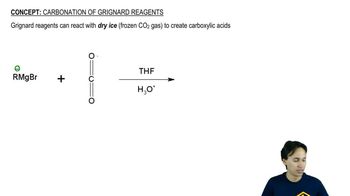
Grignard reagents are organomagnesium compounds formed by the reaction of an alkyl or aryl halide with magnesium metal in anhydrous ether. They are highly reactive nucleophiles used in organic synthesis to form carbon-carbon bonds. Understanding their structure and reactivity is crucial for analyzing side reactions like dimerization.
Recommended video:
Guided course
02:12
Carbonation of Grignard Reagents

Dimerization Mechanism

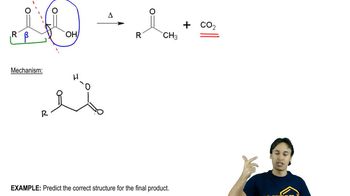
Dimerization refers to the process where two molecules combine to form a dimer, which can occur through various mechanisms. In the context of Grignard reagents, dimerization typically involves the coupling of two Grignard species, leading to the formation of a new carbon-carbon bond. This process can be facilitated by the presence of reactive intermediates or through radical pathways.
Recommended video:
Guided course
04:32
General Mechanism

Radical Intermediates

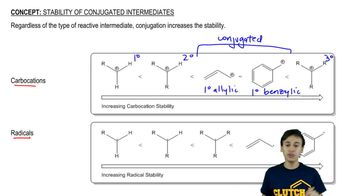
Radical intermediates are highly reactive species with unpaired electrons, often formed during chemical reactions. In the case of Grignard reagent dimerization, the formation of radical intermediates can occur through homolytic cleavage of the C-Mg bond, allowing for the coupling of two radicals to form a dimer. Understanding the role of these intermediates is essential for proposing a detailed mechanism.
Recommended video:
Guided course
04:31
Stability of Conjugated Intermediates