Ch. 11 - Organometallic Compounds
Bruice - Organic Chemistry 8th Edition
Bruice8th EditionOrganic ChemistryISBN: 9780135213711Not the one you use?Change textbook
Chapter 12, Problem 40

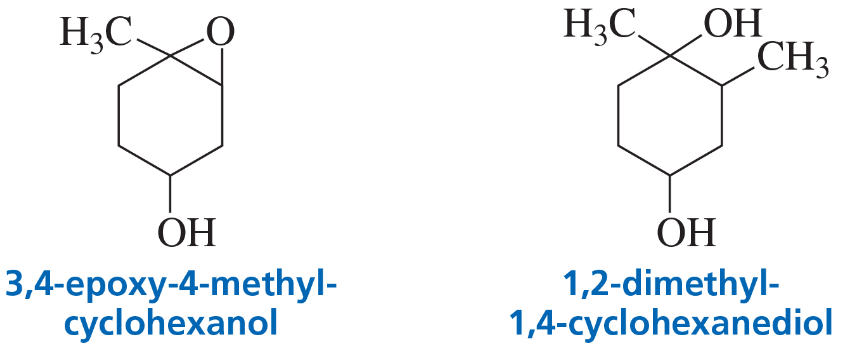
A student added an equivalent of 3,4-epoxy-4-methylcyclohexanol to a solution of methylmagnesium bromide in diethyl ether, and then added dilute hydrochloric acid. He expected that the product would be 1,2-dimethyl-1,4-cyclohexanediol. He did not get any of the expected product. What product did he get?

Verified step by step guidance
1
Step 1: Analyze the starting material, 3,4-epoxy-4-methylcyclohexanol. It contains an epoxide group (a strained three-membered ring with an oxygen atom) and a hydroxyl group (-OH) attached to a cyclohexane ring. The methyl group is located at the 4-position.
Step 2: Understand the reaction conditions. Methylmagnesium bromide is a Grignard reagent, which is a strong nucleophile and base. It reacts with electrophilic centers, such as the epoxide group, by opening the ring. The reaction occurs in diethyl ether, a common solvent for Grignard reactions.
Step 3: Predict the mechanism of the reaction. The Grignard reagent attacks the less sterically hindered carbon of the epoxide, leading to ring opening. This generates an alkoxide intermediate. The methyl group from the Grignard reagent is added to the less hindered carbon of the epoxide.
Step 4: Consider the subsequent step where dilute hydrochloric acid is added. This step protonates the alkoxide intermediate, converting it into an alcohol group. The final product will have two hydroxyl groups (-OH) and a methyl group added to the cyclohexane ring.
Step 5: Explain why the expected product, 1,2-dimethyl-1,4-cyclohexanediol, was not formed. The Grignard reagent selectively attacks the less hindered carbon of the epoxide, leading to a different regioisomer. The actual product is likely 1,4-dimethyl-1,3-cyclohexanediol, where the methyl group and hydroxyl groups are positioned differently than in the expected product.

Verified video answer for a similar problem:

This video solution was recommended by our tutors as helpful for the problem above.
Video duration:
6m
Was this helpful?

Key Concepts

Here are the essential concepts you must grasp in order to answer the question correctly.

Grignard Reagents

Grignard reagents, such as methylmagnesium bromide, are organomagnesium compounds that act as nucleophiles in organic reactions. They can react with electrophiles, including carbonyl compounds and epoxides, to form new carbon-carbon bonds. Understanding their reactivity is crucial for predicting the outcome of reactions involving these reagents.
Recommended video:
Guided course
02:12
Carbonation of Grignard Reagents

Epoxide Ring Opening

Epoxides are three-membered cyclic ethers that are highly reactive due to the strain in their ring structure. When treated with nucleophiles like Grignard reagents, epoxides undergo ring-opening reactions, leading to the formation of alcohols. The regioselectivity of this reaction depends on the nature of the nucleophile and the substituents on the epoxide.
Recommended video:
Guided course
04:34
Acid-Catalyzed Epoxide Ring-Opening

Acid-Base Reactions in Organic Chemistry

In organic chemistry, acid-base reactions often play a significant role in the workup of reactions. The addition of dilute hydrochloric acid in this scenario likely serves to protonate the alkoxide intermediate formed after the nucleophilic attack, converting it into a more stable alcohol. Understanding these reactions is essential for predicting the final products in organic synthesis.
Recommended video:
Guided course
02:43
Recognizing Acid-Base Reactions.