
Ch. 11 - Organometallic Compounds
Bruice - Organic Chemistry 8th Edition
Bruice8th EditionOrganic ChemistryISBN: 9780135213711Not the one you use?Change textbook
Chapter 12, Problem 38c

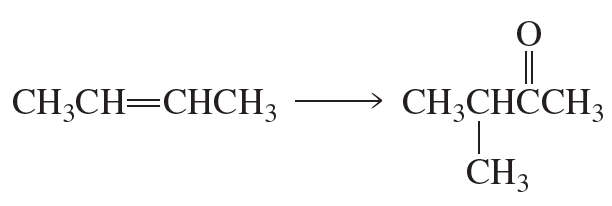
Using the given starting material, any necessary inorganic reagents and catalysts, and any carbon-containing compounds with no more than two carbons, indicate how each of the following compounds can be prepared:
c. Chemical reaction showing the conversion of butene to a carbonyl compound with structural formulas.

Verified step by step guidance
1
Step 1: Analyze the starting material and the target compound. The starting material is an alkene (1-hexene), and the target compound is a ketone (2-hexanone). This suggests that the reaction involves oxidation of the alkene to form a ketone.
Step 2: Select the appropriate reaction pathway. To convert an alkene to a ketone, one effective method is oxidative cleavage followed by rearrangement. Ozonolysis is a common reaction for cleaving alkenes into carbonyl compounds.
Step 3: Perform ozonolysis. Treat the alkene with ozone (O₃) followed by a reducing agent such as zinc (Zn) and water (H₂O) or dimethyl sulfide (DMS). This will cleave the double bond and form the corresponding ketone.
Step 4: Verify the carbon count. Ensure that the carbon skeleton of the product matches the target compound. In this case, the ketone (2-hexanone) retains the original carbon chain of the starting material.
Step 5: Confirm the functional group transformation. The reaction successfully converts the alkene functional group into a ketone functional group, completing the synthesis of the target compound.

Verified video answer for a similar problem:

This video solution was recommended by our tutors as helpful for the problem above.
Video duration:
4m
Was this helpful?

Key Concepts

Here are the essential concepts you must grasp in order to answer the question correctly.

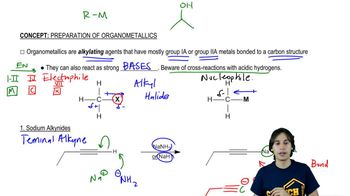
Organometallic Reagents

Organometallic reagents are compounds that contain a carbon-metal bond, where the carbon is part of an organic group. These reagents are crucial in organic synthesis as they can act as nucleophiles, allowing for the formation of new carbon-carbon bonds. Common examples include Grignard reagents and organolithium compounds, which can react with various electrophiles to create complex organic molecules.
Recommended video:
Guided course
02:50
Ruining Organometallics

Nucleophilic Addition Reactions

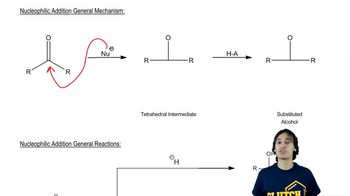
Nucleophilic addition reactions involve the attack of a nucleophile on an electrophilic center, typically a carbon atom with a partial positive charge. This type of reaction is fundamental in organic chemistry, particularly in the formation of alcohols, amines, and other functional groups. Understanding the mechanism of nucleophilic addition is essential for predicting the outcomes of reactions involving carbonyl compounds and other electrophiles.
Recommended video:
Guided course
08:27
Nucleophilic Addition

Stereochemistry

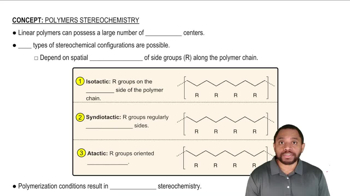
Stereochemistry is the study of the spatial arrangement of atoms in molecules and how this affects their chemical behavior. In organic synthesis, the stereochemical configuration of products can significantly influence their reactivity and biological activity. Recognizing the importance of stereochemistry is vital when designing synthesis pathways, especially when dealing with chiral centers and the potential for stereoisomer formation.
Recommended video:
1:38
Polymer Stereochemistry Concept 1