

A student added an equivalent of 3,4-epoxy-4-methylcyclohexanol to a solution of methylmagnesium bromide in diethyl ether, and then added dilute hydrochloric acid. He expected that the product would be 1,2-dimethyl-1,4-cyclohexanediol. He did not get any of the expected product. What product did he get?
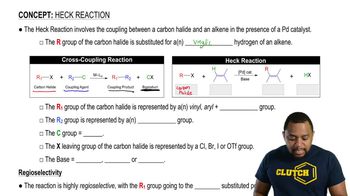
Which of the following compounds cannot be prepared by a Heck reaction?

Verified step by step guidance
Verified video answer for a similar problem:
Key Concepts
Heck Reaction
Substrate Compatibility
Functional Group Tolerance
Metathesis of which of the following sets of alkenes leads to the highest yield of a single alkene?
1. 1-butene and 1-pentene
2. 2-butene and 3-hexene
3. 2-butene and 1-pentene
Dimerization is a side reaction that occurs during the preparation of a Grignard reagent. Propose a mechanism that accounts for the formation of the dimer.
Using the given starting material, any necessary inorganic reagents, and any carbon-containing compounds with no more than two carbons, indicate how each of the following compounds can be prepared:
b.
A dibromide loses only one bromine when it reacts with sodium hydroxide. The dibromide forms toluene (C6H5-CH3) when it reacts with magnesium shavings in ether followed by treatment with dilute acid. Give possible structures for the dibromide.
For those compounds that can be prepared by a Heck reaction, what starting materials are required?
