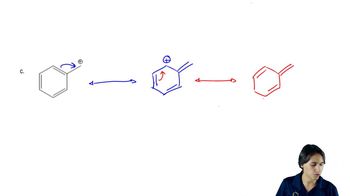
Which of the following compounds cannot be prepared by a Heck reaction?
Ch. 11 - Organometallic Compounds
Chapter 12, Problem 47
A dibromide loses only one bromine when it reacts with sodium hydroxide. The dibromide forms toluene (C6H5-CH3) when it reacts with magnesium shavings in ether followed by treatment with dilute acid. Give possible structures for the dibromide.
Verified step by step guidance1
Analyze the problem: The dibromide reacts with sodium hydroxide to lose only one bromine atom, indicating that one bromine is more reactive or accessible. Additionally, the dibromide forms toluene (C6H5-CH3) after reaction with magnesium in ether followed by dilute acid, suggesting a Grignard reaction mechanism.
Recall the Grignard reaction: Magnesium in ether reacts with alkyl halides to form Grignard reagents (R-MgX). These reagents are highly reactive and can react with water or dilute acid to form hydrocarbons. In this case, the final product is toluene, implying that the Grignard reagent must have a benzyl group (C6H5-CH2-MgX).
Consider the structure of the dibromide: For the dibromide to form toluene, it must contain a benzyl group (C6H5-CH2-) and two bromine atoms. One bromine atom must be attached to the benzyl carbon (C6H5-CH2-Br), and the other bromine atom must be elsewhere in the molecule.
Propose possible structures: The dibromide could have the following structures: (1) C6H5-CHBr2 (benzyl dibromide), where both bromine atoms are on the benzyl carbon, or (2) C6H5-CH2-Br with the second bromine atom on a different position, such as the aromatic ring (e.g., C6H4Br-CH2-Br).
Verify the reactivity: In the reaction with sodium hydroxide, only one bromine is lost. This suggests that the bromine on the benzyl carbon (C6H5-CH2-Br) is more reactive due to the stability of the benzyl carbocation intermediate. This supports the proposed structures, particularly C6H5-CHBr2 or C6H4Br-CH2-Br.

Verified video answer for a similar problem:
This video solution was recommended by our tutors as helpful for the problem above.
Video duration:
6mWas this helpful?
Key Concepts
Here are the essential concepts you must grasp in order to answer the question correctly.
Dibromide Structure
A dibromide is a compound containing two bromine atoms attached to a carbon skeleton. Understanding the possible structures of dibromides is crucial, as the arrangement of bromine atoms can influence the reactivity of the compound. In this case, the dibromide must have a structure that allows for the loss of one bromine atom during the reaction with sodium hydroxide.
Recommended video:
Guided course
Drawing Resonance Structures
Nucleophilic Substitution Reaction
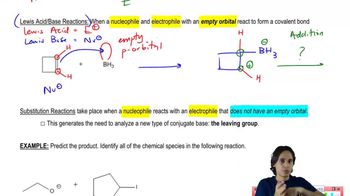
The reaction of the dibromide with sodium hydroxide involves a nucleophilic substitution mechanism, where the hydroxide ion acts as a nucleophile, replacing one of the bromine atoms. This type of reaction is common in organic chemistry and is essential for understanding how functional groups can be transformed. The nature of the leaving group and the substrate structure will determine the reaction pathway.
Recommended video:
Guided course
Nucleophiles and Electrophiles can react in Substitution Reactions.
Grignard Reaction
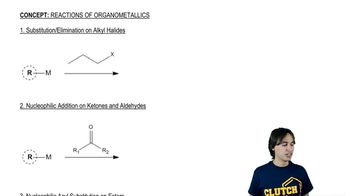
The formation of toluene from the dibromide using magnesium shavings in ether is an example of a Grignard reaction. In this process, the dibromide reacts with magnesium to form a Grignard reagent, which can then react with water or dilute acid to yield hydrocarbons. Recognizing this reaction is vital for deducing the possible structures of the dibromide, as it indicates the presence of a carbon chain that can lead to toluene.
Recommended video:
Guided course
Reactions of Organometallics
Related Practice
Textbook Question
1
views
Textbook Question
a. Show the reagents required to form the primary alcohol in each of the following reactions.
2
views
Textbook Question
Metathesis of which of the following sets of alkenes leads to the highest yield of a single alkene?
1. 1-butene and 1-pentene
2. 2-butene and 3-hexene
3. 2-butene and 1-pentene
1
views
Textbook Question
What product is obtained from ring-opening metathesis polymerization of each of the following compounds? (Hint: In each case, the product is an unsaturated hydrocarbon with a high molecular weight.)
a.
1
views
Textbook Question
What starting material is required in order to synthesize each of the following compounds by ring-closing metathesis?
a.
1
views
Textbook Question
For those compounds that can be prepared by a Heck reaction, what starting materials are required?
1
views