Ch. 10 - Reactions of Alcohols, Ethers, Epoxides, Amines, and Sulfur-Containing Compounds
Bruice - Organic Chemistry 8th Edition
Bruice8th EditionOrganic ChemistryISBN: 9780135213711Not the one you use?Change textbook
Chapter 11, Problem 13

Which of the following alcohols dehydrates the fastest when heated with acid?
Four chemical structures labeled A, B, C, and D, depicting different alcohols for dehydration reaction analysis.

Verified step by step guidance
1
Step 1: Understand the dehydration reaction mechanism. Alcohols dehydrate in the presence of acid to form alkenes. The rate of dehydration depends on the stability of the carbocation intermediate formed during the reaction.
Step 2: Analyze the structures of the alcohols provided. Look for the position of the hydroxyl (-OH) group and the substituents attached to the carbon atom bearing the hydroxyl group.
Step 3: Consider the stability of the carbocation intermediate. Tertiary carbocations are more stable than secondary carbocations, which are more stable than primary carbocations. Additionally, resonance stabilization or hyperconjugation can further stabilize the carbocation.
Step 4: Evaluate each alcohol: (A) forms a secondary carbocation, (B) forms a tertiary carbocation, (C) forms a primary carbocation, and (D) forms a tertiary carbocation with resonance stabilization due to the double bond in the ring.
Step 5: Conclude that the alcohol which forms the most stable carbocation (tertiary with resonance stabilization) will dehydrate the fastest. Based on this analysis, identify the alcohol that meets this criterion.

Verified video answer for a similar problem:

This video solution was recommended by our tutors as helpful for the problem above.
Video duration:
6m
Was this helpful?

Key Concepts

Here are the essential concepts you must grasp in order to answer the question correctly.

Dehydration of Alcohols

Dehydration of alcohols is a chemical reaction where an alcohol loses a water molecule, typically in the presence of an acid catalyst. This process often leads to the formation of alkenes. The rate of dehydration can vary significantly based on the structure of the alcohol, with tertiary alcohols generally dehydrating faster than secondary or primary alcohols due to greater carbocation stability.
Recommended video:
Guided course
01:23
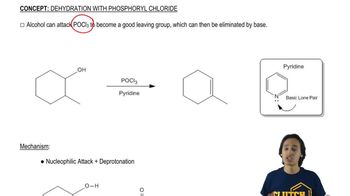
General Reaction of Dehydration with POCl3

Carbocation Stability

Carbocation stability is a key factor in determining the rate of dehydration reactions. Tertiary carbocations are more stable than secondary and primary ones because they are stabilized by the inductive effect of adjacent alkyl groups. The more stable the carbocation formed during dehydration, the faster the reaction will proceed, making the structure of the alcohol crucial in predicting the reaction rate.
Recommended video:
Guided course
05:58
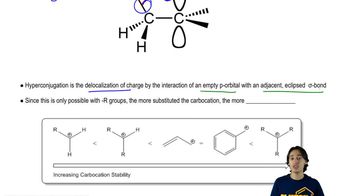
Determining Carbocation Stability

Acid Catalysis

Acid catalysis involves the use of an acid to increase the rate of a chemical reaction. In the dehydration of alcohols, the acid protonates the hydroxyl group, making it a better leaving group. This step is essential for the formation of the carbocation intermediate, which is a critical part of the dehydration mechanism, thus influencing the overall reaction speed.
Recommended video:
2:50
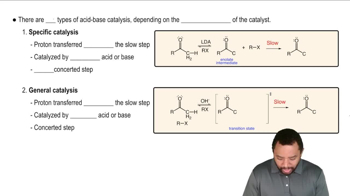
Acid-Base Catalysis Concept 3